



👩🦳 Why I’ve Never Called Anyone a “Karen.” And Why I Never Will.
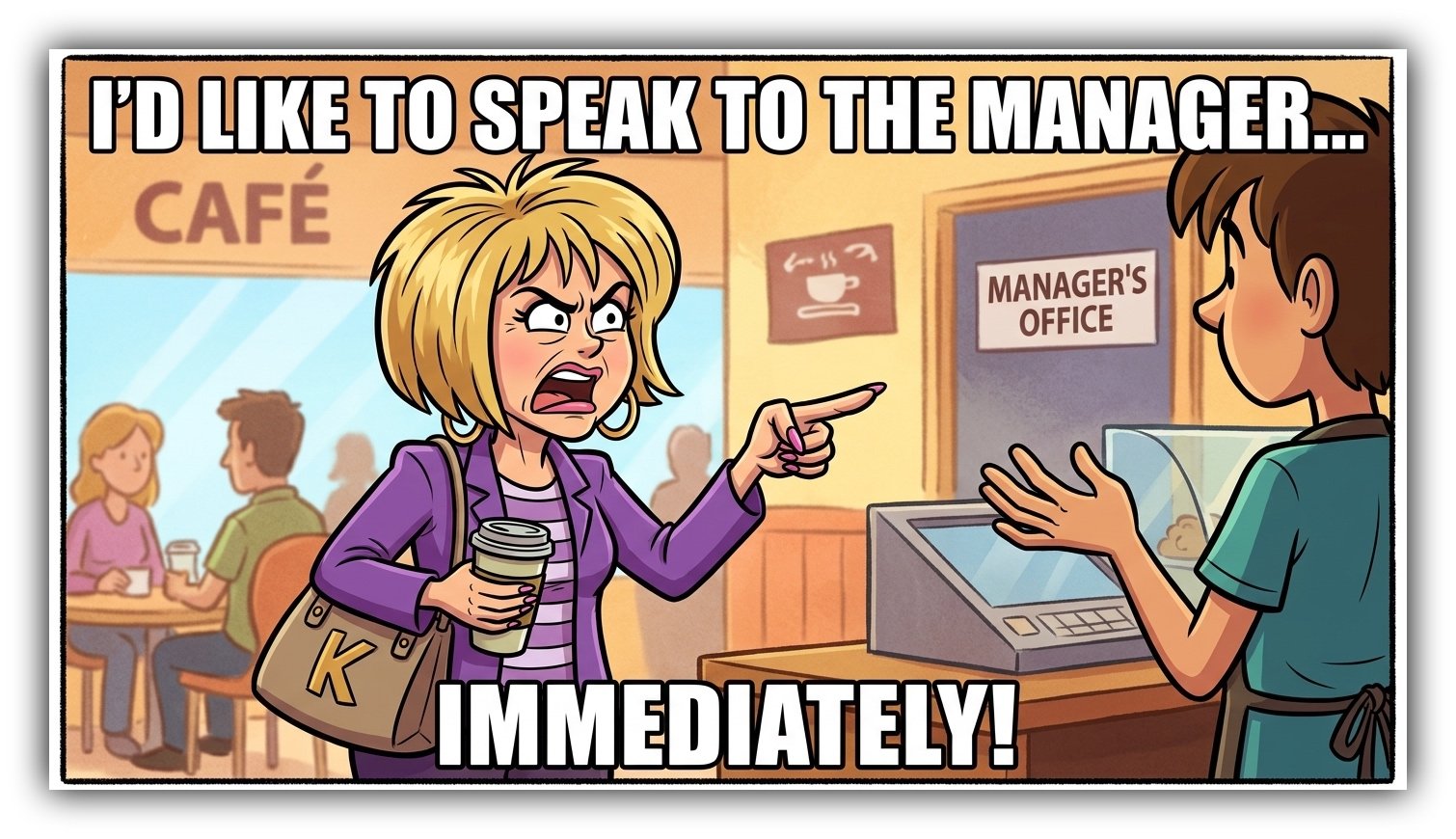
he familiar “Karen” stereotype: a blonde, middle-aged woman demanding to speak to the manager, portrayed here as a coffee-shop confrontation. The meme reflects how “Karen” has evolved into a shorthand for an allegedly entitled, angry or demanding woman, often reducing a complicated interaction to a gendered punchline. Meme created for Alaska Headline Living via Gemini.
By Gina Hill | Alaska Headline Living | Monday, August 17, 2026
If someone behaves badly, name the behavior. Don’t make her gender the punchline.
I have never called anyone a “Karen.”
And I never will.
Not because I don’t recognize the behavior the word was originally intended to describe. I do.
Not because women should be exempt from criticism. They absolutely should not.
It’s because I believe we can do better than turning a woman’s name into a catch-all insult.
The term “Karen” has a history. It became associated with Black American cultural commentary about white women using privilege to police or surveil Black people, particularly in public spaces. Researchers have documented how the meme functioned as a critique of racialized surveillance and white racial dominance.
That behavior deserves to be called out.
But so does what happened to the word afterward.
Somewhere Along the Way, “Karen” Became a Shortcut
Today, a woman doesn’t necessarily have to be racist or entitled to be called a Karen.
She can simply be:
- Angry.
- Loud.
- Assertive.
- Demanding.
- Difficult.
- Complaining.
- Unwilling to back down.
- In disagreement with someone.
That’s a pretty broad net.
And that’s the problem.
“Karen” often tells us nothing about what actually happened. It tells us only that someone didn’t like the woman or her behavior.
If she is racist, say racist.
If she is bullying someone, say bullying.
If she is abusing privilege, explain how.
If she is demanding special treatment, say that.
If she’s simply wrong, explain why.
Those descriptions are more useful because they make us examine the behavior instead of dismissing the person.
The Gender Problem
“Karen” is overwhelmingly a gendered insult.
One study examining 256 videos of people labeled as “Karens” found that women accounted for 84% of the people depicted, compared with 14% identified as men. The researcher concluded that the “Karen” identity was clearly gendered and was typically attached to women stereotypically perceived as middle-aged and white.
Of course men behave badly, too.
Men can be racist. Men can be entitled. Men can scream at employees, demand special treatment, abuse authority, throw tantrums and make ridiculous complaints.
There are male counterparts to “Karen.” “Ken” is one of them.
But none of those male labels has come close to becoming the cultural phenomenon that “Karen” has become.
And that should make us think.
Women have a long history of being dismissed with words that turn behavior into a personality defect:
- Hysterical.
- Emotional.
- Shrill.
- Bossy.
- Difficult.
- Nasty.
Now we have “Karen.”
The vocabulary changes. The basic mechanism doesn’t.
A woman is angry, outspoken or unwilling to make herself smaller, and suddenly the conversation becomes about her personality rather than what she is saying.
Calling her a “Karen” doesn’t hold her accountable. It dismisses her.
“Karen” is simply “shut up” dressed up as a joke.
A Woman Can Be Angry and Still Be Right
This may be the part we most often forget. A woman can be unpleasant and still have a legitimate complaint. She can raise her voice and still be telling the truth. She can be frustrated and still be justified. She can be demanding because something genuinely needs to be fixed. And yes, she can also be completely wrong.
The point is that we should determine which one it is.
Research published in 2026 examining Karen memes found that the label has expanded beyond its original context and can be used for public shaming, labeling and attacking women of different ages and ethnicities. The researchers also found that Karen memes can reinforce the idea that loudness and overreaction are feminine characteristics.
That matters because women have spent generations being told that being too loud, too angry or too assertive makes them unacceptable.
I don’t want to contribute to that.
I’m Not Defending Bad Behavior
Let’s be clear about what I’m saying. I’m not saying women shouldn’t be criticized. I’m saying criticism should be specific.
If someone makes a racist accusation, call out the racism.
If someone mistreats a server, call out the mistreatment.
If someone abuses authority, call out the abuse.
If someone behaves like a bully, call them a bully.
If someone is entitled, call them entitled.
Those words tell us something. “Karen” often doesn’t.
I Have Better Words
This is why I have never used the word. I don’t need a woman’s first name to describe racism. I don’t need it to describe entitlement. I don’t need it to describe bullying. And I don’t need it to dismiss a woman simply because she is loud, angry, assertive, older or inconvenient.
I have better words. More precise words. Words that describe what happened instead of reducing a woman to a punchline.
If someone behaves badly, I’ll tell you what she did. That’s more honest.
And it leaves the name “Karen” out of it. Exactly where I intend to keep it.
So I’ve never called anyone a “Karen.”
And I never will.
Sources
Naomi Schoenbaum, “Misogyny and the Politics of Womanhood,” American Journal of Law and Equality, MIT Press, 2024.
This is the MIT Press source I originally included. Importantly, Schoenbaum specifically discusses the “Karen” meme, including the tension between its use to expose white racial privilege and the sexism involved when the meme places responsibility for racism disproportionately on women while potentially letting white men off the hook.
Pilar Garcés-Conejos Blitvich, “Karen: Stigmatized social identity and face-threat in the on/offline nexus,” Journal of Pragmatics, 2022.
The study analyzes 256 videos and finds that the “Karen” identity is strongly gendered, with women involved in 84% of the incidents examined. It also examines the stereotype’s associations with entitlement, rudeness, racism and confrontations in public spaces.
Read the study at ScienceDirect
Suay Melisa Özkula and Patricia Prieto-Blanco, “Just a meme? The role of context in mythologies of memetic misogyny,” New Media & Society, 2026.
This multiplatform study examines Karen memes on Reddit, YouTube and Twitter/X and finds that the label can be used to shame, mock and attack women. The researchers also specifically discuss how Karen memes can encourage viewers to interpret loud women as overreacting and reinforce gendered stereotypes about women.
Read the study at SAGE Journals
Apryl Williams, “Black Memes Matter: #LivingWhileBlack With Becky and Karen,” Social Media + Society, 2020.
This research provides important context for the racial origins and cultural meaning of “Karen” and related memes, particularly their use to critique white surveillance and racialized policing of Black people.
Read the study at SAGE Journals
Diane Negra and Julia Leyda, “Querying ‘Karen’: The Rise of the Angry White Woman,” European Journal of Cultural Studies, 2021.
This article examines the cultural construction of the “Karen” stereotype, including its intersections with race, gender, age and the cultural expectations placed on women.
Read the article at SAGE Journals
What do you feel about this post?

Like

Love

Happy

Haha

Sad