








🗳️ Ballot Measure No. 2: 💰 Follow the Money, 🔎 See the Fine Print
Who’s funding Measure 2, and what happens to Alaska’s disclosure rules?
You’ve probably seen the signs:
YES ON 2.
NO ON 2.
The fight is about more than ranked-choice voting. Ballot Measure 2 would change how Alaska runs its elections and roll back several campaign-finance rules adopted in 2020. So who is paying for the fight? And what would actually change if the measure passes?
Let’s make it simple.
Measure 2 Changes How You Vote
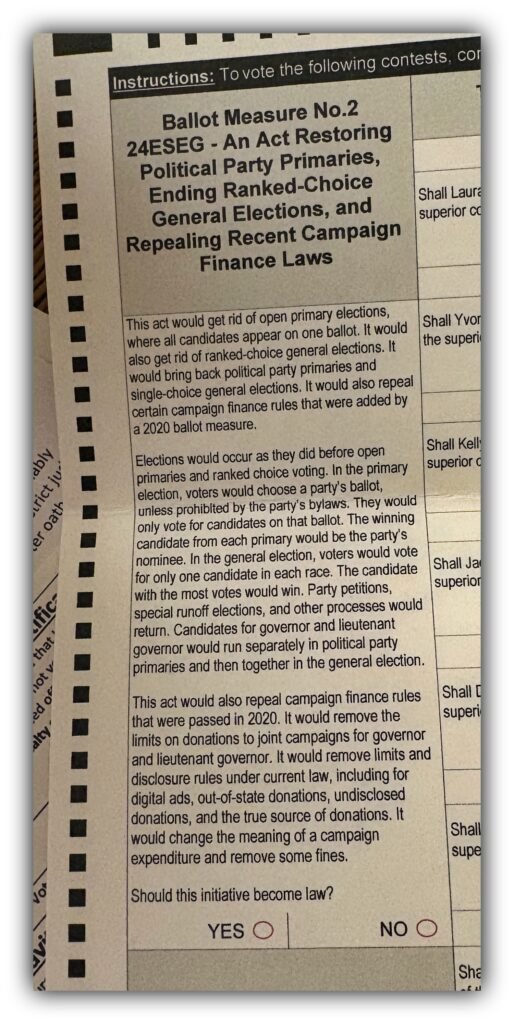
Alaska now uses an open primary. All candidates run on the same primary ballot, and the top four move on to the general election. The general election uses ranked-choice voting. Voters can rank candidates in order.
Measure 2 would repeal that system.
A YES vote would bring back party primaries, where voters choose a party’s ballot, and single-choice general elections, where voters pick one candidate.
The candidate with the most votes would win.
Other parts of Alaska’s former election system would also return, including special runoff elections and party petitions.
But there is another part of Measure 2 that can be easy to miss.
It Also Changes Money Rules
The measure would repeal or change several campaign-finance rules adopted in 2020.
Those rules deal with things such as:
- Identifying the true source of political donations
- Donations coming from outside Alaska
- Undisclosed donations
- Digital political advertising
- Some reporting requirements and penalties
In other words, this ballot measure isn’t only about how Alaskans vote. It also changes some of the rules about how political money is reported.
First, What Is “Dark Money”?
“Dark money” isn’t a legal term.
It generally means political money that moves through one or more organizations, making it harder for the public to see who originally supplied the money. That doesn’t mean every large donation is dark money. A donor can give a large amount through an organization and still be publicly identified.
That’s where the Measure 2 money trail gets interesting.
Follow the Money
The YES campaign is Repeal Now.
Its latest complete campaign disclosure report reviewed for this article covered money through July 17, 2026. It reported about $754,000 in total contributions.
The largest outside source was Aurora Action Network, which reported contributions to Repeal Now. One July filing connected a $1.5 million contribution from Elon Musk to Aurora Action Network, while Aurora separately reported giving $1 million to Repeal Now.
That is a trail:
Elon Musk → Aurora Action Network → Repeal Now
It does not prove that Musk’s specific $1.5 million became the specific $1 million contribution to Repeal Now. Money held by an organization can be used for different purposes.
Aurora’s *Alaska Public Offices Commission (APOC) filings also identify other donors, including Jeff Yass and Jeffery Hildebrand.
The NO campaign is No on 2.
Its latest complete campaign disclosure report reviewed for this article covered money through July 7, 2026. It reported about $5.76 million in contributions and about $1.02 million in spending.
Its largest contributors included Unite America PAC and Voters for the American Center.
One APOC filing shows Unite America giving $600,000 directly to No on 2 in May. Another filing shows Voters for the American Center making three $500,000 contributions in June, totaling $1.5 million.
And Unite America’s own Alaska disclosures identify donors behind its money.
Among them:
- Michael Bloomberg: $2.5 million
- John Arnold: $1.25 million
- David Randolph Peeler: $995,000
- Marc Merrill: $995,000
Those are donations to Unite America, not direct donations to No on 2.
So one documented trail looks like this:
Michael Bloomberg → Unite America → No on 2
Again, that does not mean Bloomberg’s particular dollars can be traced into a particular No on 2 check.
The Money, Side by Side
| YES ON 2 | Money Trail | NO ON 2 | Money Trail |
|---|---|---|---|
| Elon Musk | $1.5 million → Aurora Action Network → Repeal Now | Michael Bloomberg | $2.5 million → Unite America → No on 2 |
| Jeff Yass | At least $675,000 → Aurora Action Network | John Arnold | $1.25 million → Unite America → No on 2 |
| Jeffery Hildebrand | $25,000 → Aurora Action Network | Voters for the American Center | $1.5 million directly to No on 2 |
The important point is simple:
Both campaigns have received substantial money from outside Alaska. The difference is in the organizations and people supplying that money, and in how that money is reported.
What Happens to the Disclosure Rules?
This is where the ballot language deserves a careful read.
If Measure 2 passes, several campaign-finance rules adopted in 2020 would be repealed or changed.
That includes rules involving the disclosure of the true source of donations, out-of-state money, undisclosed donations and some digital advertising requirements.
That doesn’t mean Alaska would suddenly have no campaign-finance reporting. APOC would still exist and campaign groups would still have reporting requirements.
The change is that some of the newer disclosure requirements would disappear or be changed.
And that’s where the money trail takes center stage.
So What Does Your Vote Do?
Here it is in plain English:
| If you vote… | Here’s what happens |
|---|---|
| YES | Alaska’s open Top 4 primary and ranked-choice general election are repealed. Party primaries and single-choice general elections return. Several 2020 campaign-finance disclosure rules are also repealed or changed. |
| NO | Alaska keeps the current open Top 4 primary, ranked-choice general election and the campaign-finance provisions covered by the measure. |
That’s the actual choice on the ballot.
Read Past the Campaign Signs
Measure 2 is easy to describe as a fight over ranked-choice voting. It is more than that.
A YES vote changes Alaska’s election system and rolls back parts of the state’s newer campaign-finance rules.
A NO vote keeps the current election system and those provisions in place.
Meanwhile, millions of dollars are moving through political organizations on both sides of the fight.
The public records show where much of that money came from and where it went. They also show where the trail becomes less direct because money passes through another organization.
That’s the part worth understanding before you vote.
Your ballot deserves more than a slogan.
Read the measure. Follow the money. Then make your own decision.
Sources
- Alaska Division of Elections: Ballot Measure 2 status, official ballot language and initiative information. Alaska Division of Elections: Ballot Measures
- Alaska Division of Elections: Official updated Ballot Measure 2 language, including the proposed changes to Alaska’s election system and campaign-finance laws. Official Measure 2 Ballot Language
- Alaska Public Offices Commission (APOC): Campaign disclosure records for Repeal Now and No on 2, including contributions and expenditures. APOC Campaign Disclosure Search
- Alaska Public Offices Commission (APOC): Independent expenditure and political organization disclosure records used to trace contributions and reported sources of funds. APOC Independent Expenditure Reports
* APOC is the state agency that oversees and enforces Alaska’s laws on campaign finance, lobbying, and financial disclosure.
What do you feel about this post?

Like

Love

Happy

Haha

Sad