






The “No to Dark Money” Sign That Gets It Backward
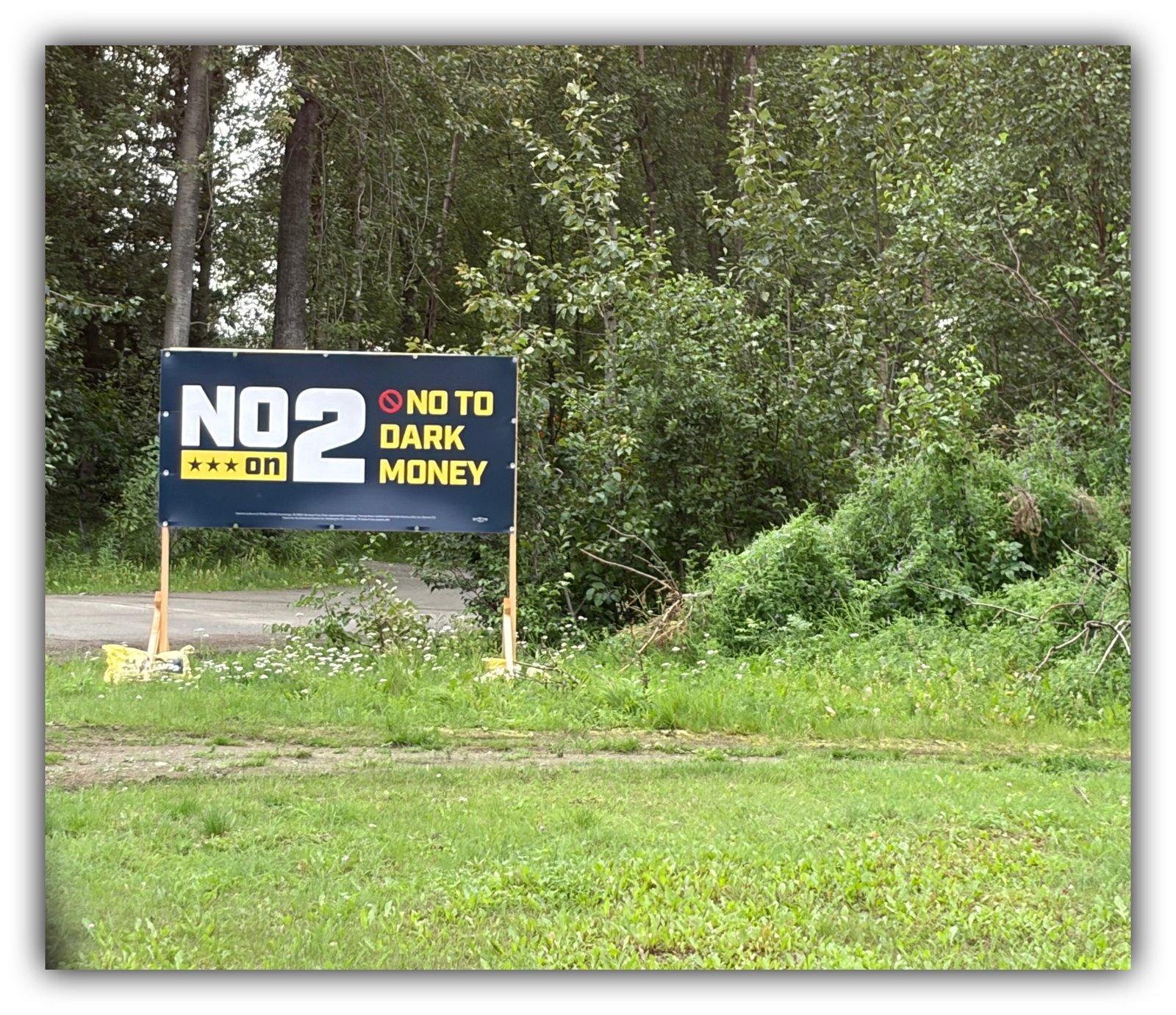
A political sign in Wasilla, Alaska, promotes a “vote yes” message by presenting the measure as a safeguard for voters while leaving out the measure’s connection to dark-money spending. The selective framing can give voters an incomplete picture of what their vote would actually do. Photo courtesy of James Hill for Alaska Headline Living.
The sign invokes voters’ fear of hidden political spending to argue against the measure that restores limits on direct campaign contributions.
By Gina Hill | Alaska Headline Living | Wednesday, August 19, 2026
The sign is simple: “No on 2. No to Dark Money.”
It is also misleading. Alaska voters approved Ballot Measure 2 on Aug. 18, 2026, restoring limits on political contributions after a federal court ruling eliminated the state’s previous caps. Once the measure takes effect, it will limit direct donations to state and local candidates and political groups.
The sign borrows voters’ opposition to dark money to argue against limits on unlimited direct campaign contributions.
Why Ballot Measure 2 Existed
Alaska voters approved campaign-contribution limits in 2006, including a $500 annual cap on what an individual could give to a candidate. In 2021, the Ninth Circuit Court of Appeals struck down the state’s limits after concluding the $500 cap was unconstitutionally low.
That decision left Alaska without enforceable limits on direct contributions to state and local candidates and political groups. Wealthy donors could give unlimited amounts directly to campaigns.
Ballot Measure 2 was placed before voters to restore contribution limits at higher levels intended to address the court’s concerns. Voters approved it on Aug. 18.
What Ballot Measure 2 Will Do
After the measure takes effect, it will:
- Limit an individual’s contributions to a candidate to $2,000 per election cycle.
- Limit a group’s contributions to a candidate to $4,000 per election cycle.
- Limit annual contributions to political parties and certain political groups to $5,000.
- Set higher limits for joint governor and lieutenant governor campaigns.
- Require periodic adjustments for inflation.
The measure will not end unlimited independent political spending. Organizations that make only independent expenditures, rather than giving directly to candidates or coordinating with campaigns, will still be able to raise and spend unlimited sums.
That is why contribution limits and disclosure laws both matter. One limits the size of direct checks. The other helps voters identify who is financing political activity outside a candidate’s campaign.
What the Sign Concealed
“Dark money” generally means political spending whose original funding source is hidden from the public. Direct contributions are not necessarily hidden, but unlimited direct contributions can still give wealthy donors extraordinary influence.
The sign treats those separate problems as though they point to the same answer. They do not.
A voter can oppose secret political spending and support limits on direct contributions. In fact, that is the more coherent position: require political spenders to disclose their true financial backers and prevent a single donor from writing an unlimited check to a candidate.
Instead, the sign turns “dark money” into a catchall phrase. It does not tell voters that a No vote would have kept the post-2021 status quo of unlimited direct donations.
Political signs are supposed to be concise, not exhaustive. But brevity does not require inversion. When “No to Dark Money” is used to argue against a measure that will limit unlimited direct campaign donations, it is not simply incomplete. It is a deliberate effort to blur the distinction between transparency and contribution limits.
Sources
- Alaska Division of Elections, official 2026 election materials and ballot-language summary for Ballot Measure 2.
- Thompson v. Hebdon, U.S. Court of Appeals for the Ninth Circuit, 2021 ruling invalidating Alaska’s prior $500 individual contribution limit.
- Alaska Public Offices Commission, campaign-finance guidance following the 2021 decision.
What do you feel about this post?

Like

Love

Happy

Haha

Sad