









Two Dan Sullivans, Two New York Times Stories, and an Alaska Election Under Scrutiny
Two candidates named Dan Sullivan are at the center of a controversy surrounding Alaska’s 2026 U.S. Senate race. Left: incumbent Sen. Dan S. Sullivan (official photo). Right: Dan J. Sullivan of Petersburg (AP Photo/Katie Holmlund via Courthouse News).
With early voting underway, allegations about a candidate with a familiar name have triggered a state investigation, a federal lawsuit and calls for prosecution. But a reporter’s investigation is not a court verdict, and headlines should never replace evidence.
Alaskans are already casting ballots in the 2026 U.S. Senate race, with Election Day set for Tuesday, November 3. The contest could help determine which party controls the U.S. Senate. Now two New York Times stories by reporter Kellen Browning have put Democratic candidate Mary Peltola, her campaign and the two men named Dan Sullivan under an intense spotlight.
The September story examined allegations about Peltola’s treatment of campaign staff. The October investigation alleged that people connected to her campaign and national Democrats worked to recruit candidates who could draw votes away from Republican Sen. Dan S. Sullivan.
Both stories raise questions worth examining. So does the way they present their claims.
This is not an argument that the allegations should be ignored. It is a call to separate documented evidence from disputed accounts, political interpretation and conclusions that have not been established in court.
What Browning’s October Investigation Claims

In “Inside Democrats’ Secret Effort to Stack Alaska’s Ballot,” published October 28, Browning reported that Peltola campaign aides, lawyers and Democratic Senatorial Campaign Committee officials were involved in efforts to recruit candidates intended to weaken Republican support.
The story describes interviews with 12 people, dozens of text messages and documents prepared for a potential lawsuit. It also reports discussions about recruiting another Dan Sullivan, encouraging a Democrat to withdraw and possibly creating a new right-wing political party.
Those are serious allegations. The reporting points to messages and people who reportedly participated in or heard about the effort. Readers should examine that evidence carefully.
But an important source was Elisa Rios, Peltola’s former campaign manager, who was fired during an August staff shake-up. The Times disclosed that she was planning to file a wrongful-termination lawsuit, then sought to retract her statements shortly before publication. The newspaper said her account was consistent with its other reporting.
Those details matter. A source’s employment dispute does not automatically make the source unreliable. Nor does a retraction automatically erase previous statements. But readers deserve to know the source’s circumstances and how independently the claims were corroborated.
The Times says it reviewed text messages. Some are quoted in the article, but the underlying collection of messages has not been published alongside the story. Readers therefore cannot independently inspect the full documentary record from the article alone.
When a Headline Starts Shaping the Verdict
The headline calls it a “Secret Effort to Stack Alaska’s Ballot,” while words like “spoilers” and “dilute” frame the alleged strategy as an attempt to manipulate the outcome. That framing can shape readers’ conclusions before they have weighed the evidence, the other side of the story and what has actually been established.

That language conveys the investigation’s central allegation in forceful terms. It also frames the story before readers reach the evidence, denials and unresolved questions.
The distinction matters. Evidence that campaign operatives discussed recruiting candidates is not automatically proof that every person named knew about or approved the plan. Evidence of a political strategy is not, by itself, proof of a crime. And a source’s account of what a candidate knew is not the same as direct evidence of that candidate’s participation.
The article reports that Rios said Peltola was aware of the project but was not directly involved. Peltola’s campaign denied involvement in either Sullivan campaign and denied recruiting candidates. The Democratic Senatorial Campaign Committee also denied participating.
Those denials do not settle the matter. But they are part of the record, and the evidence for each claim should be evaluated separately.
The story also acknowledges that ballot-composition tactics are common in politics, generally legal and have been used by both parties in Alaska. That context is important. If the practice is being examined as a threat to fair elections, comparable conduct by Republicans and Democrats deserves the same scrutiny.
The September Story: Is Mary Peltola Judged by a Different Standard?
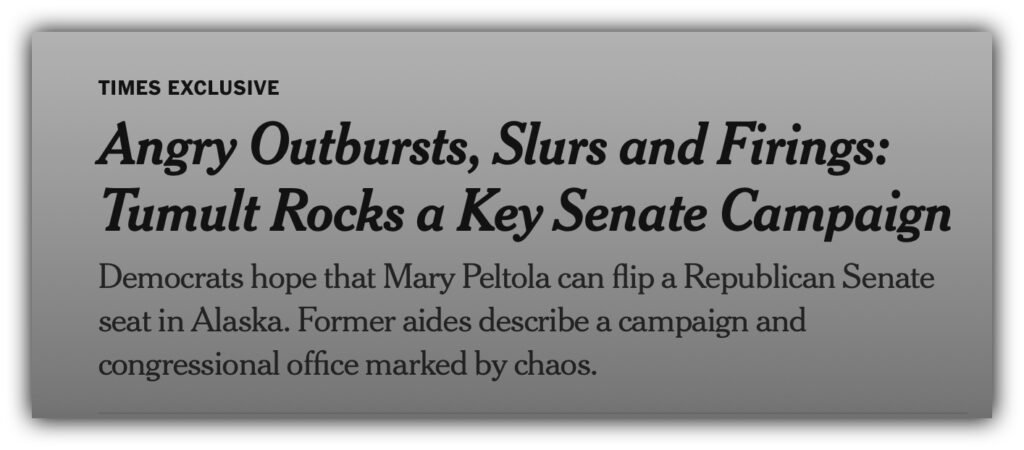
Browning’s September 23 headline, “Angry Outbursts, Slurs and Firings: Tumult Rocks a Key Senate Campaign,” framed Mary Peltola through anger and conflict. The Times cited former staffers, text messages and other material to support its reporting. Peltola’s campaign disputed parts of the account, and other former aides offered more favorable views of working with her.
The allegations deserve scrutiny. So does the framing.
When a man raises his voice, he may be called forceful, tough or demanding. When a woman does it, is she more readily portrayed as volatile or difficult? That gendered double standard is a legitimate question in political coverage, even though the headline alone cannot prove Browning’s intent.
The issue is not whether a woman should be exempt from criticism. She should not. It is whether women face a different threshold for being labeled too angry or too emotional, while comparable behavior from men is treated as strength.
The story was soon used in a Republican-aligned super PAC’s attack ad against Peltola. That does not make the reporting false, but it shows how quickly allegations can become political ammunition.
Women should be held accountable for their conduct. They should not have to overcome gender stereotypes on top of the evidence against them. And no reporter’s framing should substitute for readers’ own judgment.
The Legal Record is Not a Verdict on Every Allegation
The controversy over Dan J. Sullivan’s candidacy began months before the October story.
In June, Alaska’s Division of Elections ruled that Daniel J. Sullivan of Petersburg had not filed a good-faith candidacy and had sought to confuse or mislead voters. The decision followed complaints brought on behalf of Alaska Republican Party leadership.
But the state courts ultimately allowed him to remain on the ballot. The Alaska Supreme Court’s decision protected his right to run; it did not establish every fact about who may have recruited him or why.
The federal government has since sued over certification of the Senate election, seeking action if votes for Dan J. Sullivan of Petersburg change the outcome for the incumbent. The State of Alaska has argued that the lawsuit lacks a legal basis and could interfere with state election administration and the secrecy of the ballot.
As of this article’s publication, the allegations in the Times investigation have not resulted in a court finding that Peltola committed a crime. Political demands for prosecution are not legal findings, either.
The presumption of innocence applies in criminal proceedings. Journalists do not have to wait for a trial before reporting allegations, but they do have a responsibility to distinguish accusations from established facts.
When Political Accusations Become Calls for Prosecution
President Donald Trump has gone beyond criticizing Mary Peltola. He has called for her to resign from the race and be criminally prosecuted. But a president’s demand is not evidence of guilt, and an investigation is not a conviction.

Public officials can demand accountability. They should also respect the distinction between allegations and proven criminal conduct, especially when their words can influence public opinion and put pressure on the legal process.
You can investigate a candidate. You can challenge her account. You can demand evidence and accountability. But accusation, political pressure and proof of criminal guilt are three different things. Alaskans deserve to know which is which.
Timing, Consistency and Accountability
The October investigation appeared less than a week before Election Day, while Alaskans were already voting. Browning told Alaska’s News Source that the Times had been working on the story for at least a month and was not trying to influence the election.
Timing alone does not prove improper motive. Newsworthy evidence does not become unpublishable because an election is near. But when a story lands during active voting and carries potentially serious consequences for a candidate, careful language and transparent sourcing become especially important.
The same standard must apply to all sides. Republican-backed efforts to influence Alaska’s ballot, outside spending on lesser-known candidates and the actions of political committees deserve scrutiny, too. Reporting should not treat a tactic as acceptable or ordinary when one party uses it and as evidence of wrongdoing when the other does.
The question is not whether Browning should have published these stories. It is whether readers have been given enough evidence and context to distinguish what the reporting documents from what sources allege and what political figures claim those allegations mean.
What Alaskans Should Demand
Readers should ask a few straightforward questions:
- What evidence directly supports each major claim?
- Which claims depend on a single source, and which are independently corroborated?
- Were the responses from the people accused accurately represented and given meaningful consideration?
- Does the story distinguish a campaign tactic from conduct that a court has found illegal?
- Are comparable tactics by both political parties examined using the same standards?
These questions protect the public’s ability to determine what the evidence actually shows.
A newspaper investigation can uncover important information. It can also leave unanswered questions. A dramatic headline cannot fill those gaps, and a political figure’s demand for prosecution cannot turn an allegation into a conviction.
Alaskans deserve rigorous reporting, transparent evidence and equal scrutiny of both parties. We should neither dismiss serious allegations because they are politically inconvenient nor accept them as proven because they appear in a prominent newspaper.
Read the original reporting. Read the responses, ie: the other side of the story. Follow the court record. Ask what is documented, what remains disputed and what has actually been decided.
An election is too important to surrender our judgment to a headline.
Stay informed. Stay inspired. Stay curious.
Sources
- The New York Times investigation, republished by The Philadelphia Inquirer: “Inside Democrats’ Secret Effort to Stack Alaska’s Ballot”
- Alaska Public Media: “Peltola campaign and national Dems recruited spoiler candidates, including Petersburg Sullivan, according to New York Times”
- Alaska’s News Source: Browning discusses his reporting, sources and timing
- The New York Times’ September 23 story on Peltola’s campaign, as covered by Alaska Public Media
- Alaska Division of Elections: June 15, 2026, final determination on Daniel J. Sullivan’s candidacy
- Alaska Public Media: “State of Alaska says DOJ lawsuit over Senate race ‘has no legal basis’”
- Reuters: Report on the New York Times investigation and the responses from both parties
What do you feel about this post?

Like

Love

Happy

Haha

Sad