









Google’s AI or N Google Search? Schools Face a Difficult Choice
Students use laptops during classroom instruction as schools navigate the growing role of artificial intelligence in education. Photo courtesy of Discovery Education.
Google says schools can control student access to artificial intelligence. But districts that want AI completely out of the classroom may have to give up traditional Google Search, too.
Schools teach students to find information, question what they read, evaluate sources and reach their own conclusions.
Google’s latest education policy raises an uncomfortable question: Can schools protect those skills without giving up one of their most familiar research tools?
In an announcement Tuesday, November 3, Google said it is changing access to four products for students using school-managed K-12 accounts: Gemini, Gemini Notebook, Gemini in Classroom and Google Search.
Under the new arrangement, access to all four products will be turned off by default. School administrators must explicitly enable them.
That sounds like more control for schools. But there is a catch.
Google’s education chief says schools that want artificial intelligence completely turned off will also have to turn off Google Search.
In interviews with education publication Chalkbeat and Forbes, Google’s vice president and general manager of Education, Chris Phillips, explained that AI is deeply integrated into Search. Schools cannot simply remove the AI features and retain conventional Google Search under the arrangement he described.
In other words, schools may have to choose between Google’s AI-enabled search product and no Google Search access through school-managed student accounts.
Search and AI: A Package Deal?
Consider a school district that wants students to research historical events, locate original documents, compare scientific studies and examine competing accounts.
Administrators may welcome traditional search tools but object to AI-generated summaries and answers appearing before students have examined the underlying information.
That is a reasonable distinction. Finding information and having artificial intelligence interpret it are not the same activity.
Yet Google’s explanation leaves schools without the option of keeping conventional Search while rejecting its AI integration.
Google has not announced a traditional-search-only setting.
The policy does not shut down Google Search for the general public or prevent students from using personal Google accounts. It concerns access through school-managed K-12 accounts.
Google says additional implementation details will be provided in the coming months. Chalkbeat reports that testing with selected U.S. schools is expected to begin in November, with broader implementation planned for early 2027.
Google Wants AI to Teach, Not Just Answer
The company is also promoting Guided Learning, a feature designed to help students work through problems instead of simply handing them answers.
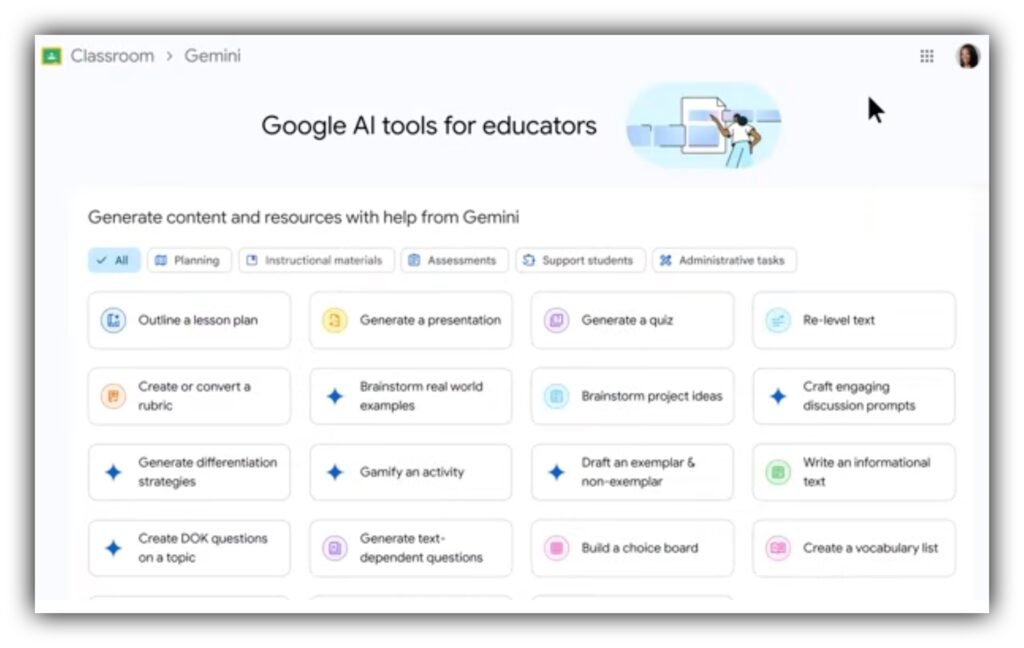
Google says Guided Learning will become available globally in Google Classroom on November 3. A pilot bringing the feature to Search is planned for selected U.S. schools later this month.
The approach is intended to encourage students to work through questions step by step, a process Google describes as productive struggle.
That concept gets at the heart of the educational debate.
Learning isn’t just about arriving at the right answer. It’s about developing the ability to figure out how to get there.
Google’s November 2026 report, AI in Education: From Potential to Practice, acknowledges concerns about academic integrity, cognitive offloading and the effects of AI on critical thinking.
The company is promoting AI as a learning tool while also acknowledging the risks of students relying on it too heavily.
Can AI Weaken Critical Thinking?
We asked ChatGPT whether artificial intelligence could weaken critical thinking.
The short answer: Yes.
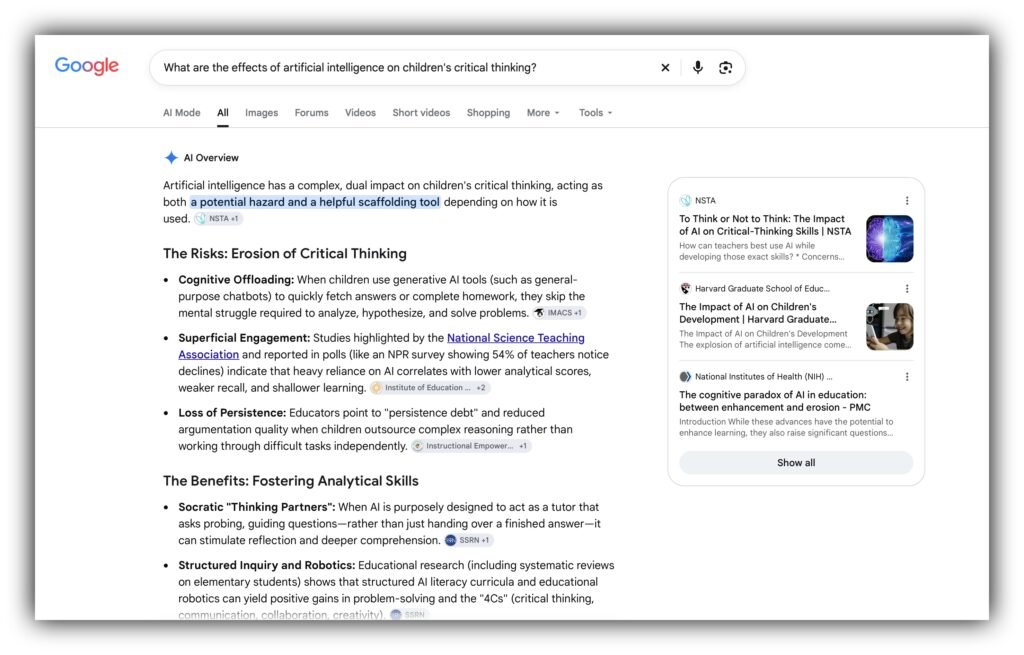
AI can make it easy to confuse getting an answer with understanding an answer.
When students routinely ask AI to write essays, solve problems, summarize reading assignments and supply explanations, they risk missing the mental work that builds independent reasoning.
AI can sound convincing and still be wrong. Students who haven’t learned to question information may accept an inaccurate answer without examining the evidence.
But AI can also help students challenge arguments, compare explanations, identify weaknesses in reasoning and explore opposing viewpoints. The difference is whether they use it to strengthen their thinking or replace it.
Children and teenagers need opportunities to develop independent reasoning, research and problem-solving skills before becoming dependent on technology to perform those tasks.
Our conclusion:
“Teach children how to think before teaching them to let a machine think alongside them.”
That’s an AI-generated perspective, not an independent educational research finding. But it raises an important question: Are schools teaching students to use AI, or making it easier for them to rely on AI before they’ve learned to think independently?
Who Gets to Decide?
Google says its new controls will give schools greater authority over student access to its products. But parents have a stake in this decision, too.
They deserve to know what AI tools their children are using at school, how those tools influence learning, what information is being collected and whether students can access traditional search without AI-generated answers.
Parents should ask their school districts some important questions:
- Will our district enable Google’s AI products for students?
- Can parents review the technology and features their children are expected to use?
- How will teachers ensure students are developing independent research and critical-thinking skills?
- What alternatives are available for families who have concerns about classroom AI?
- Will parents have a meaningful opportunity to provide input before these decisions are made?
School administrators have a responsibility to make informed technology decisions. But parents shouldn’t have to discover those decisions after the technology is already in their children’s classrooms.
Google has not announced a way for schools to separate conventional Search from its AI features. That is a question school districts should put directly to the company, and one parents have every reason to ask, too.
AI is becoming part of everyday life. Children need to understand how to use it, question it and recognize its limitations. But they also need the opportunity to think independently, evaluate evidence and reach their own conclusions.
Parents should not be passive observers as artificial intelligence changes education. They should be part of the conversation, part of the decision-making process and part of protecting their children’s ability to think for themselves.
AI can help students learn. But it should never become a substitute for learning how to think.
Sources
- Google: Designing Responsible AI for Learning (November 3, 2026).
- Google: AI in Education, From Potential to Practice (November 2026).
- Google: Learn About Gemini in Google Classroom.
- Google for Education: Privacy and Security FAQs.
- Chalkbeat: Google Promises to Stop Doing Students’ Homework for Them (November 3, 2026).
- Forbes: Schools Can Say No to Google AI. But They’ll Lose Google Search Too (November 3, 2026).
Alaska Headline Living | Stay inspired. Stay informed. Stay curious.
What do you feel about this post?

Like

Love

Happy

Haha

Sad