







Trump Questions Whether Alaskans Know What “Incumbent” Means
A graphic featuring President Donald Trump’s October 30, 2026, remarks during an interview with Kansas City radio host Pete Mundo. Trump questioned whether Alaskans and voters elsewhere understand the meaning of “incumbent” and said it takes a “190 IQ” to figure out Alaska’s U.S. Senate ballot. Trump is pictured at right.
President says voters need a 190 IQ to understand Alaska’s Senate ballot, raising questions about his characterization of Alaska voters and the federal government’s intervention in the race.
Alaska voters apparently need an exceptionally high IQ to understand their own election ballots. At least, that’s what President Donald Trump suggested during a radio interview Friday, October 30.
Speaking with Pete Mundo on Kansas City’s Mundo in the Morning, Trump criticized Alaska’s U.S. Senate ballot, which lists two candidates with similar names: incumbent Republican Sen. Dan S. Sullivan and challenger Daniel J. Sullivan, Jr.
“Did you get to look at the ballot where the, you, you have to be, you need about 190 IQ to figure out the ballot,” Trump said.
He then questioned whether Alaskans understand the word identifying the sitting senator.
“Most people don’t know in Alaska, and a lot of other states too, what does incumbent mean? They don’t know what incumbent means. Incumbent.”
Trump also repeated his characterization of the situation as voter fraud, comparing it to his claims about the 2020 presidential election.
The interview comes as the Trump administration continues its legal effort to challenge the handling of Alaska’s Senate election.
What Does Incumbent Mean?
For the record, incumbent is a common election term. It identifies the person who currently holds the office being contested.
In Alaska’s Senate race, that person is Dan S. Sullivan, the sitting Republican senator seeking reelection.
The Alaska Division of Elections lists the candidates differently:
- Sullivan, Daniel J. Jr. appears without a party affiliation.
- Sullivan, Dan S. appears with the designation Registered Republican and Incumbent.
- Peltola, Mary appears as Registered Democrat.
- Heikes, Gerald appears as Registered Republican.
The candidates are listed alphabetically by last name. The two Sullivans have different first names and middle initials, and the incumbent’s party affiliation and current officeholder status are identified.
Alaska’s ranked-choice voting system allows voters to rank as many or as few candidates as they choose.
How Did Two Dan Sullivans End Up on the Ballot?

The presence of Daniel J. Sullivan, Jr. has become a major controversy in the Senate race.
The retired teacher from Petersburg entered the race and advanced through Alaska’s August top-four primary. He received approximately 2.5% of the vote.
The incumbent and his supporters have questioned whether the second Sullivan entered the race to confuse voters and divert support from the sitting senator.
Earlier this year, the Alaska Division of Elections attempted to keep Daniel J. Sullivan off the ballot, citing concerns about voter confusion and his candidacy.
The Alaska Supreme Court ultimately upheld a lower court decision allowing him to remain on the ballot.
The court’s decision meant election officials could not exclude a qualified candidate simply because they believed his candidacy might confuse voters.
Subsequent reporting by The New York Times described communications suggesting that Democratic operatives connected to Mary Peltola’s campaign helped recruit the second Sullivan.
Peltola has denied knowing about the effort.
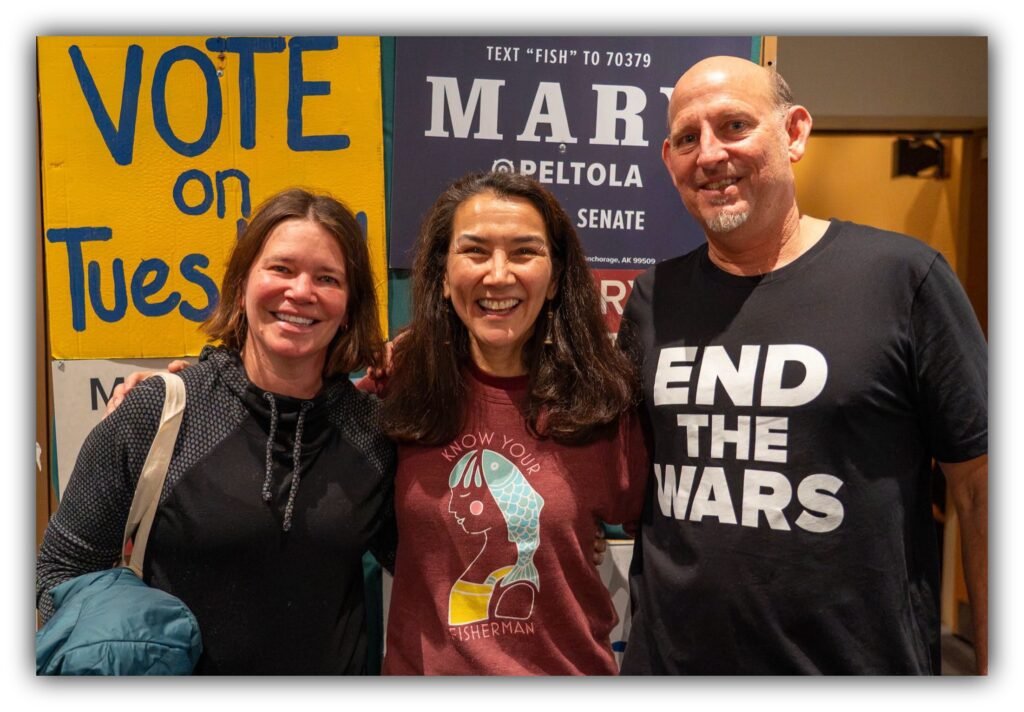
On October 29, she told an audience in Juneau that she knew nothing about another candidate on the ballot other than herself and the incumbent. She said she was not interested in tricking voters.
Gov. Mike Dunleavy announced plans for a state investigation following the latest reporting. The Justice Department has also escalated its investigation, with new grand jury subpoenas reported October 30.
Allegations about recruitment and possible voter confusion remain subjects of investigation. They are not, by themselves, proof that voters were deceived or that election fraud occurred.
Washington Takes the Alaska Ballot Dispute to Court
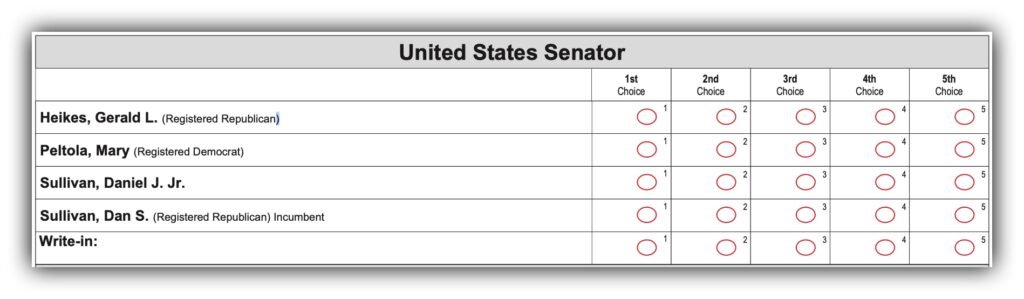
Source: Alaska Division of Elections, 2026 General Election Sample Ballot (HD1-JD1).
The Trump administration’s involvement goes beyond the president’s public comments.
The U.S. Department of Justice filed a lawsuit seeking to prevent Alaska from certifying its U.S. Senate election under certain circumstances if incumbent Dan Sullivan loses.
The federal government argues that votes intended for the incumbent could mistakenly be cast for Daniel J. Sullivan, Jr. because of their similar names.
The lawsuit seeks an investigation if the election results suggest that confusion over the two candidates could have affected the outcome.
The State of Alaska has pushed back.
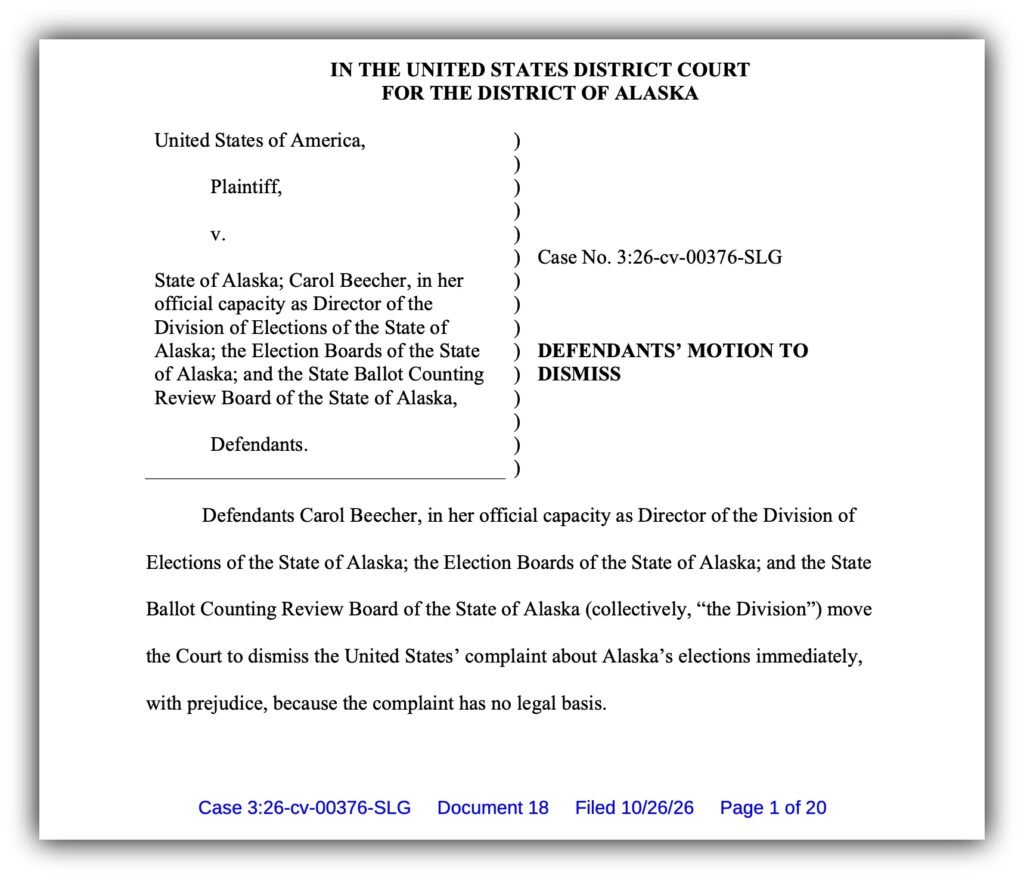
Source: U.S. District Court filing, Motion to Dismiss for Failure to State a Claim, filed October 26, 2026. Attorneys for the state: Margaret Paton-Walsh.
In an October 26 court filing, the Alaska Department of Law argued that the federal lawsuit has no legal basis and that delaying certification only if a particular candidate loses would interfere with the state’s administration of its election.
The state also pointed out that Alaska’s ranked-choice system allows voters who are uncertain to rank both Sullivans in succession, preserving their preference for either candidate over other choices.
The state raised another problem: determining what a voter intended on a secret ballot could be difficult without compromising ballot secrecy.
Republican Sen. Lisa Murkowski has also criticized the federal lawsuit, saying Alaskans do not need help voting for their preferred candidates and that the state has already distinguished the candidates on the ballot.
Alaska Voters Have Handled Complicated Ballots Before
Alaska has a history of voters navigating unusual election circumstances.
In 2010, Lisa Murkowski won reelection to the U.S. Senate through a write-in campaign after losing the Republican primary. Voters had to write her name on their ballots rather than select her from the printed candidate list.
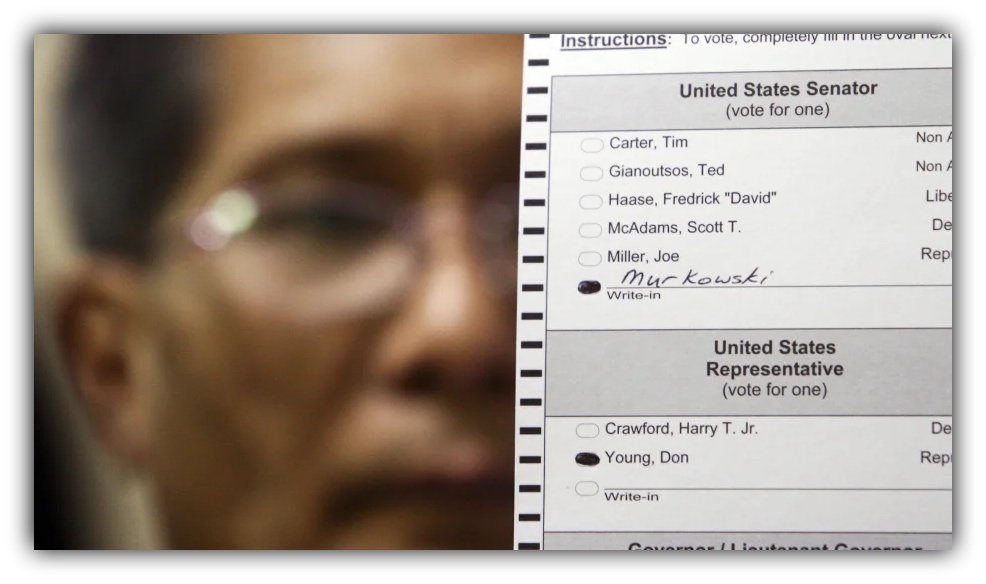
Photo: Eric Engman/Getty Images, via NPR.
In 2020, Alaska voters approved a new election system that replaced party primaries with an open, nonpartisan primary and introduced ranked-choice voting for general elections.
The system was first used in 2022.
Ranked-choice voting requires voters to understand how to rank candidates in order of preference. Voters can rank one candidate, several candidates or all candidates. They are not required to rank every name.
The system is different from traditional voting, but Alaskans have been using it in statewide elections for several years.
That history does not mean every ballot is automatically clear to every voter. It does demonstrate that Alaska voters have experience with an election system that requires more than marking a single name.
A Question of Respect for Alaska Voters
Trump’s remarks raise a question beyond the controversy surrounding the two candidates.
The circumstances surrounding Daniel J. Sullivan’s candidacy have prompted investigations by state and federal authorities. Questions include who recruited him, whether campaign operatives coordinated those efforts, what the candidates and campaigns knew, and whether any conduct violated state or federal law. Those questions deserve examination, but allegations and investigations are not proof that a crime occurred.
But suggesting that most Alaskans do not understand the word incumbent is a broad characterization of an entire state’s voters.
The president’s comments also come as his administration is asking a federal court to intervene in how Alaska certifies its Senate election results.
Alaska’s elections are administered by the state, and its voters have the right to choose their representatives. The courts can resolve legal disputes, but the votes belong to the people who cast them.
Alaskans can understand a ballot, evaluate candidates and decide for themselves whom to support.
Alaska’s ballots are for Alaskans to read, and Alaska’s elections are for Alaskans to decide.
Respectfully, Mr. President, Alaska knows how to read its own ballot.
Sources
- Donald Trump interview with Pete Mundo, October 30, 2026
- Alaska Division of Elections: 2026 General Election Sample Ballots
- Alaska Public Media: State of Alaska says DOJ lawsuit over Senate race has no legal basis, October 27, 2026
- CBS News: Two Dan Sullivans: What to know about Alaska’s Senate race, October 30, 2026
- Associated Press: What’s going on with Dan Sullivan and Dan Sullivan? The Alaska Senate litigation, explained
- The Guardian: Alaska Democrat says she knew nothing about effort to put two Dan Sullivans on ballot, October 30, 2026
- Reuters: Trump escalates legal challenges as US midterm elections near, October 30, 2026
Alaska Headline Living | Stay informed. Stay inspired. Stay curious.
What do you feel about this post?

Like

Love

Happy

Haha

Sad