



Who Says Mary Peltola Isn’t “Alaskan”? Follow the Money
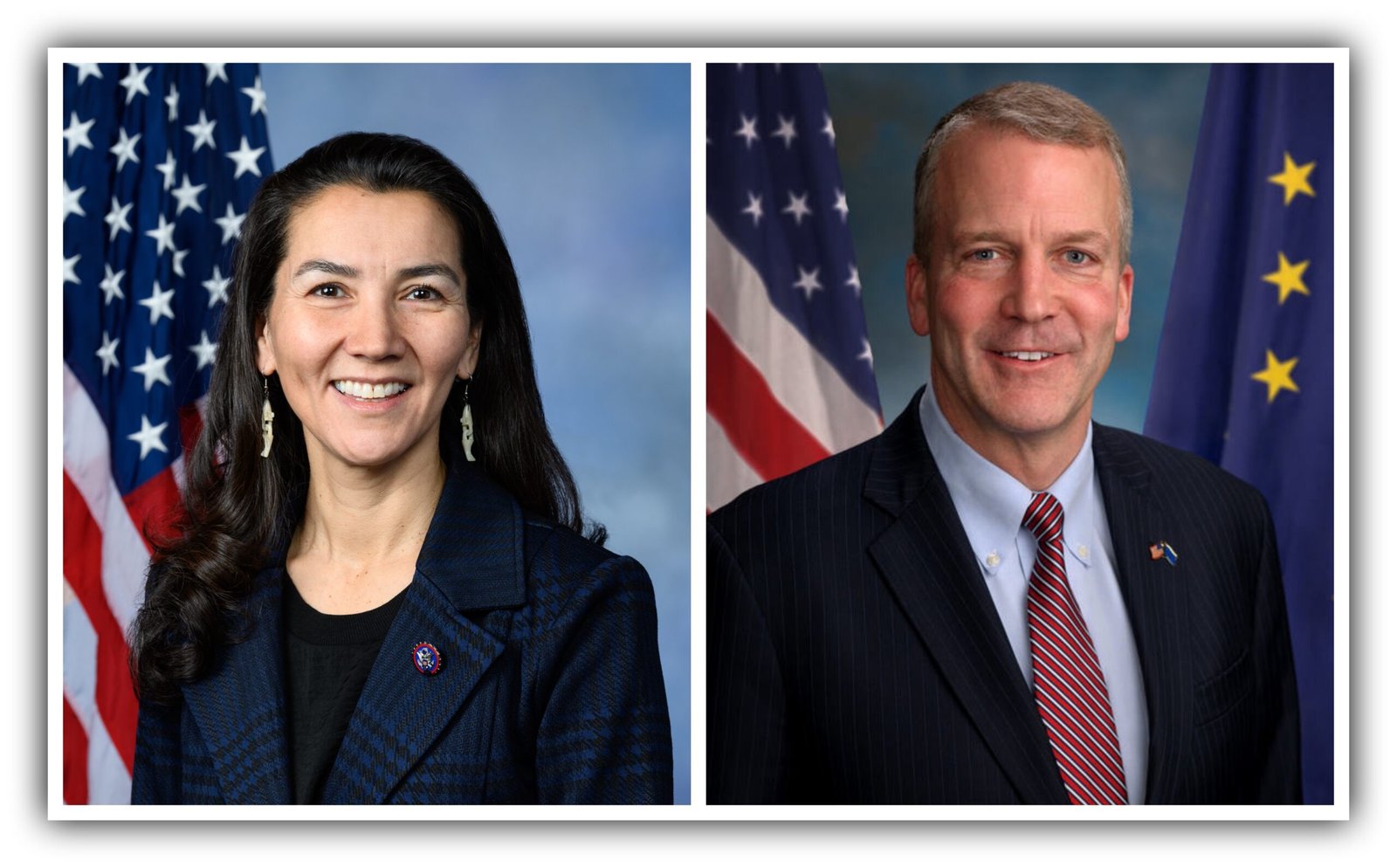
Mary Peltola, left, and Dan Sullivan, right, are candidates in Alaska’s 2026 U.S. Senate race. Peltola, born in Anchorage, served in the Alaska House before winning a 2022 special election to Congress. Sullivan, born in Ohio, has served as Alaska’s U.S. senator since 2015 after previously serving as Alaska attorney general and commissioner of the Department of Natural Resources.
A national Republican super PAC is spending millions in Alaska. Its new ad says Mary Peltola was dressed up to look like one of us. Her biography tells a very different story.
Mary Peltola was born in Anchorage, grew up along the Kuskokwim and built a political career in Alaska long before she went to Washington. She is an enrolled member of the Orutsararmiut Traditional Native Council and served in the Alaska House representing the Bethel area.
So when a new political ad says Peltola was essentially dressed up and put on a stream to “look like an Alaskan,” there is a straightforward question worth asking: Who is making that argument, and who is paying for it?
“Made Her Look Like an Alaskan”
The ad, titled “Mary Peltola Sold Out Alaskans,” attacks Peltola’s political record and her relationship with Washington Democrats. Then it takes a more personal turn.
One narrator says, “They dressed her up, threw her up out on a stream somewhere, and made her look like an Alaskan.”
The ad continues: “Mary Peltola looks like an Alaskan, but chose a different line in Washington, D.C.”
Watch the ad:
The commercial is not paid for directly by Dan Sullivan’s campaign. Its disclaimer Senate Leadership Fund as the sponsor.
That puts the ad in the hands of a national political organization rather than an Alaska campaign committee. Senate Leadership Fund is a Republican super PAC created in 2015 by allies of former Senate Majority Leader Mitch McConnell. Super PACs can accept unlimited contributions, but they must disclose their donors to the Federal Election Commission and cannot coordinate their spending with candidate campaigns.
Follow the Money
Senate Leadership Fund announced an initial $15 million investment in Alaska to support Sullivan’s reelection in April, calling it the group’s largest-ever investment in Alaska. By August, the organization announced another $12 million in Alaska advertising, bringing its stated investment in the race to $27 million.
The group is operating on a national scale. Senate Leadership Fund announced an initial $342 million investment across eight Senate races, including Alaska.
Its 2026 fundraising has included some of the country’s most prominent Republican donors. FactCheck.org reported that the group had raised $253.7 million through June 30, 2026, including major contributions from Miriam Adelson, Paul Singer and Elon Musk.
But that’s not the entire money trail.
Senate Leadership Fund has also received at least $46 million from One Nation, a Republican-aligned 501(c)(4) nonprofit. One Nation does not publicly disclose its donors.
That’s where the term dark money comes into the picture.
Senate Leadership Fund itself is not a dark-money organization. Its super PAC filings disclose its contributors. But when money comes from an organization such as One Nation, whose own donors are not publicly identified, the public can see the immediate source of the contribution without necessarily seeing who supplied the money in the first place.
Calling the Sullivan ad itself a “dark money ad” would oversimplify the situation. A more accurate description is that a national Republican super PAC is paying for the ad, and that super PAC has received tens of millions of dollars from a nonprofit that does not disclose its donors.
Now, About That “Alaskan” Claim
The political argument in the ad is fair game. Sullivan’s campaign and its allies can argue that Peltola’s voting record does not represent Alaska. Voters can examine her congressional record, statements and policy positions and reach their own conclusions.
But the commercial also asks viewers to question whether Peltola is genuinely Alaskan.
That is a factual question with a substantial historical record behind it.
The U.S. House’s official biography documents Peltola’s Alaska birth, Alaska Native affiliation and political career. Her public record includes service on the Bethel City Council, in the Alaska House of Representatives and later with the Kuskokwim River Inter-Tribal Fish Commission.
Sullivan has a different Alaska story. He was born in Fairview Park, Ohio, moved to Alaska as an adult and later served as Alaska Attorney General and Natural Resources Commissioner prior to becoming a U.S. Senator.
Here is the basic biographical record:
| Mary Peltola | Dan Sullivan | |
|---|---|---|
| Birthplace | Anchorage, Alaska | Fairview Park, Ohio |
| Alaska Native affiliation | Enrolled member of the Orutsararmiut Traditional Native Council | No comparable Alaska Native affiliation documented |
| Alaska roots | Kuskokwim River region, including Kwethluk and Bethel | Moved to Alaska as an adult |
| Alaska political career | Bethel City Council; Alaska House, 1999–2009; U.S. House, 2022–2025 | Alaska attorney general; Alaska Department of Natural Resources commissioner; U.S. Senate |
| Kuskokwim connection | Grew up in the region and later led the Kuskokwim River Inter-Tribal Fish Commission | Has only lived in Anchorage and Washington, D. C. as an adult. |
The comparison doesn’t determine which candidate better represents Alaska. It provides context for an advertisement that makes Alaska identity part of its argument.
The Ad Wants You to Look at Peltola. We Looked at the Money.
There is nothing unusual about a political campaign arguing that an opponent has abandoned Alaska values in Washington. That’s politics, and voters can judge those arguments against the record.
This ad goes further by suggesting that Peltola’s Alaska identity itself was manufactured for political purposes.
The available historical record shows that she was born in Alaska and had an Alaska political career before entering Congress.
At the same time, the organization paying for the ad is not an Alaska political group. It is a national Republican super PAC that has committed millions of dollars to the Alaska Senate race. Some of its funding comes from publicly disclosed donors. Some has flowed through a nonprofit whose donors are not publicly disclosed.
The ad tells Alaskans to look at Peltola and question her authenticity.
We looked at the money instead.
It didn’t lead to the Kuskokwim.
Sources
- U.S. House Office of the Historian, Mary Peltola biography.
- University of Chicago Institute of Politics, Mary Peltola biography.
- Alaska Division of Elections, official election materials and candidate biographies.
- Senate Leadership Fund, Alaska investment announcements.
- Senate Leadership Fund, 2026 national investment announcement.
- Federal Election Commission, Senate Leadership Fund filings.
- FactCheck.org, Senate Leadership Fund financial and organizational information.
- Senate Leadership Fund, “Mary Peltola Sold Out Alaskans” advertisement.
What do you feel about this post?

Like

Love

Happy

Haha

Sad