

Peltola Fires Back at NYT Report: ‘Fabrications’ and ‘Exaggerations’
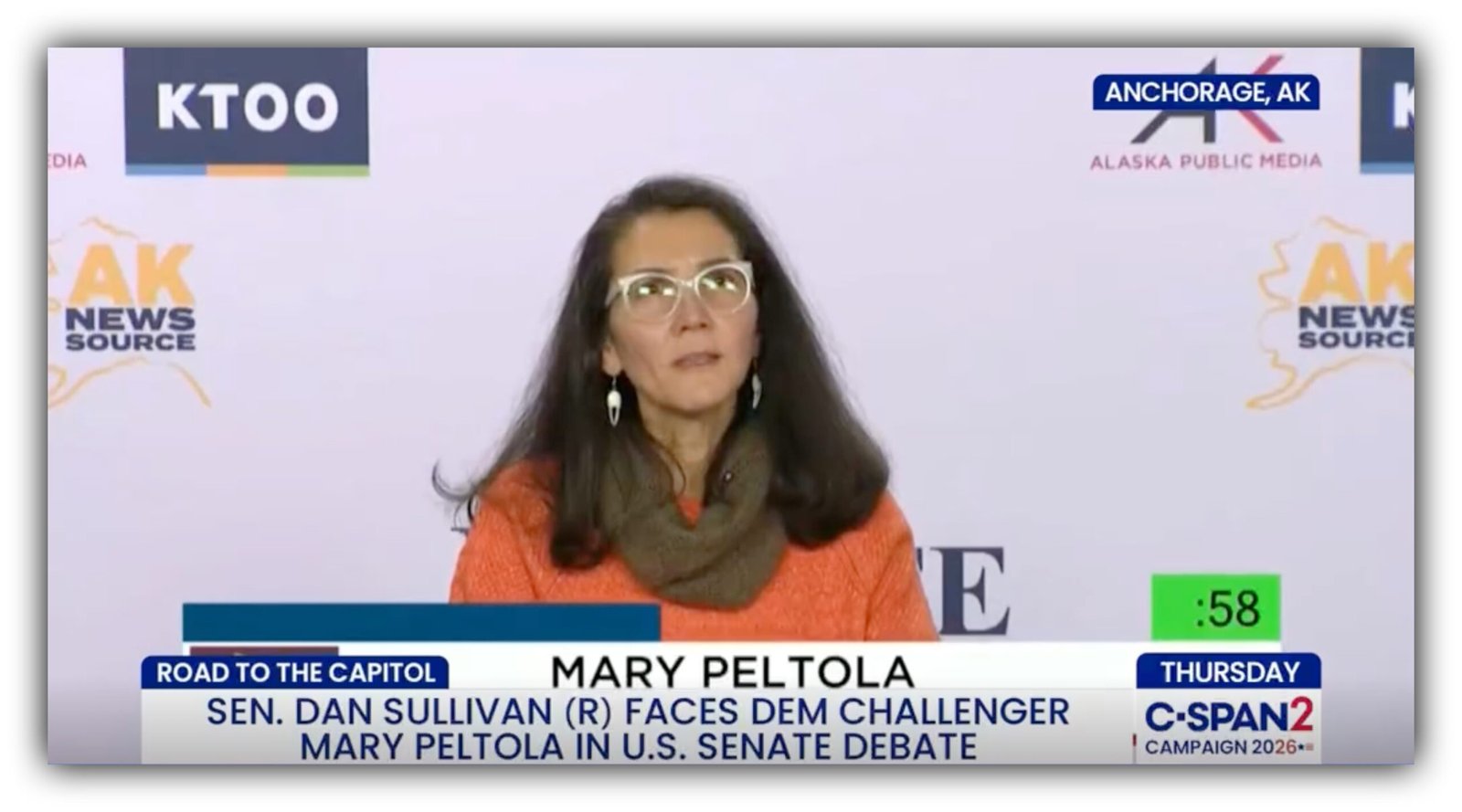
Mary Peltola responds to allegations of staff mistreatment during the Oct. 15 Senate debate, saying the election should not be defined by her worst moments. Photo courtesy of C-SPAN.
At Thursday’s Senate debate, Peltola disputed allegations of staff mistreatment detailed in a New York Times report that did not name the nine former aides behind the claims.
Mary Peltola pushed back Thursday night against allegations that she mistreated congressional and campaign aides, describing many of the claims reported by The New York Times as “outright fabrications or mass exaggerations of the truth.”
Speaking during the Oct. 15 “Debate for the State” against Republican U.S. Sen. Dan Sullivan, the Democratic Senate candidate said the election should not be defined by her behavior “on my worst day.”
“I do not think that this election is about me on my worst day, and I found so many of these allegations concerning and outright fabrications or mass exaggerations of the truth,” Peltola said.
The Times’ Sept. 23 report described alleged angry outbursts, offensive slurs and physical confrontations involving Peltola and staff members. The newspaper did not identify the nine former staff members whose accounts formed the basis of the allegations. It said they requested anonymity out of fear of retaliation and concern for their professional reputations.
Peltola Responds During Debate
Sullivan repeatedly raised the report during Thursday’s debate. Peltola defended her relationships with employees and suggested the allegations were being used to damage her candidacy.
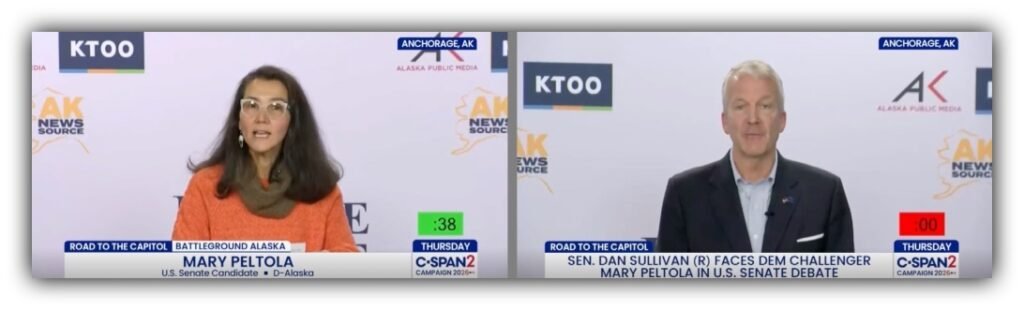
“It’s hard not to consider staff members part of your family with the amount of time that you spend together, the kind of pressure that you endure, and I really am very concerned about making sure that we are respectful and respectful of all people,” she said.
Peltola also said: “I think it’s a real sad statement that I’m such a threat as a candidate that they’re just willing to do and say anything about me to help Dan win.”
In those remarks, she did not specify which allegations she considered fabricated and which she believed were exaggerated. Her comments followed an initial response issued through her campaign after the Times article appeared.
Campaign Disputed Incidents, Cited Grief
Peltola’s campaign rejected the characterization of a pattern of abusive behavior and said she had struggled with grief following the deaths of her mother and husband in 2023.
“Exaggerating and outright lying about moments from the hardest period of her life, and falsely presenting them as a pattern of behavior, is wrong,” campaign spokesman Harry Child said in the initial response.
The campaign responded differently to individual allegations. It denied that Peltola used a homophobic slur, which four former staff members told the Times they had directly heard her use.
It also disputed an account that she deliberately pushed a male aide in the chest in February 2024, saying she accidentally bumped him. The campaign said the incident occurred on her late husband’s first birthday after his death.
A former aide’s allegation that Peltola shoved a water bottle into a staff member’s face was also contested. Two people who were in the room and remained connected to the campaign described the interaction as playful and calm.
The campaign acknowledged that Peltola regretted using a slur about people with intellectual disabilities in a text message, saying she recognized the word was inappropriate.
Gender Can Shape Perceptions of Anger
Research offers another consideration when evaluating descriptions of a female candidate as angry or volatile: women and men can face different judgments for expressing anger at work.
In three experiments published in the journal Psychological Science in 2008, researchers Victoria Brescoll and Eric Luis Uhlmann found that participants assigned lower status to women expressing anger in professional settings than to men expressing anger. Both male and female participants demonstrated the bias. They were more likely to attribute a woman’s anger to her personality, while viewing a man’s anger as a response to circumstances.
The findings provide context for evaluating descriptions of Peltola’s temperament, but they do not establish that the allegations against her were motivated by gender bias. They also do not resolve the separate allegations involving slurs or physical contact.
Times Cited Unnamed Sources and Documents
The Times did not identify the nine former staff members behind the allegations, saying they requested anonymity out of fear of retaliation and concern for their professional reputations.
The newspaper said reporter Kellen Browning interviewed those former employees and more than 20 other people in Peltola’s political orbit, and reviewed more than 100 screenshots of text messages and other images. Those totals describe the scope of the reporting, but, not the number of people corroborating each allegation, or percentages of positive versus negative comments received in total about Mary Peltola.
Because the nine former staff members were not identified, readers cannot independently assess their backgrounds or potential conflicts of interest. The Times’ statement that it reviewed documentary material should also not be confused with making that material available for readers to examine, which it did not do.
Former Employees Offered Differing Accounts
In subsequent reporting, the Alaska Beacon contacted more than a dozen former Peltola aides. Some, speaking anonymously, said they could not confirm every incident but that the Times report reflected the “tone and mood” of their experiences in her congressional office or campaign.
Those sources told the Beacon they wanted to speak frankly and that their current professional roles might require them to work with Peltola again. Their reasons for requesting anonymity were separate from the explanation the Times provided for its sources.
Other former employees offered more favorable accounts. Kate Consenstein, who worked for Peltola in the Alaska Legislature, described her as “kind, generous, and not an abusive boss.” Consenstein also made clear she was not dismissing other people’s experiences, saying she did not know who those individuals were.
Fick told the Beacon he did not consider Peltola abusive, while also describing organizational problems and saying he would not sign up to work in the operation again.
🎥 Watch C-SPAN’s coverage of the full Oct. 15 debate between Mary Peltola and Sen. Dan Sullivan, including their exchanges over affordability, fishing policy and allegations about Peltola’s treatment of staff.
Sources
- Alaska Public Media, Alaska’s News Source and KTOO: Full recording of the Oct. 15, 2026, “Debate for the State” between Mary Peltola and Dan Sullivan. Primary source for the debate itself.[alaskasnewssource][youtube]
- The New York Times, Sept. 23, 2026: Original investigation, including former aides’ allegations, the newspaper’s explanation of source anonymity, documentary material and responses from Peltola’s campaign and defenders. Primary reporting on the allegations, not an independent finding that each allegation occurred.[nytimes]
- Alaska Public Media, Oct. 15, 2026: “Sullivan, Peltola trade verbal blows, accuse the other of lying during ‘Debate for the State.’” Reporting supporting the debate quotations used above.[alaskapublic]
- The Hill, Oct. 16, 2026: “Peltola, Sullivan spar in fiery final Alaska Senate debate: ‘Let’s have some decorum.’” Additional reporting supporting Peltola’s quoted debate remarks.[thehill]
- Alaska’s News Source, Sept. 24, 2026: “Peltola avoids questions over NYT story documenting volatile behavior towards staff.” Reporting on the campaign’s initial statement and responses to specific allegations.[alaskasnewssource]
- Alaska Beacon, republished by Alaska Public Media, Sept. 25, 2026: “A New York Times article claimed hostility by Mary Peltola. Will it affect Alaska’s Senate race?” Original follow-up interviews with former employees.[alaskapublic]
- Victoria L. Brescoll and Eric Luis Uhlmann, “Can an Angry Woman Get Ahead? Status Conferral, Gender, and Expression of Emotion in the Workplace,” Psychological Science, March 2008. Original research examining how gender affects judgments of workplace anger.
What do you feel about this post?

Like

Love

Happy

Haha

Sad