





Alaska’s Surge of Child Exploitation Cases
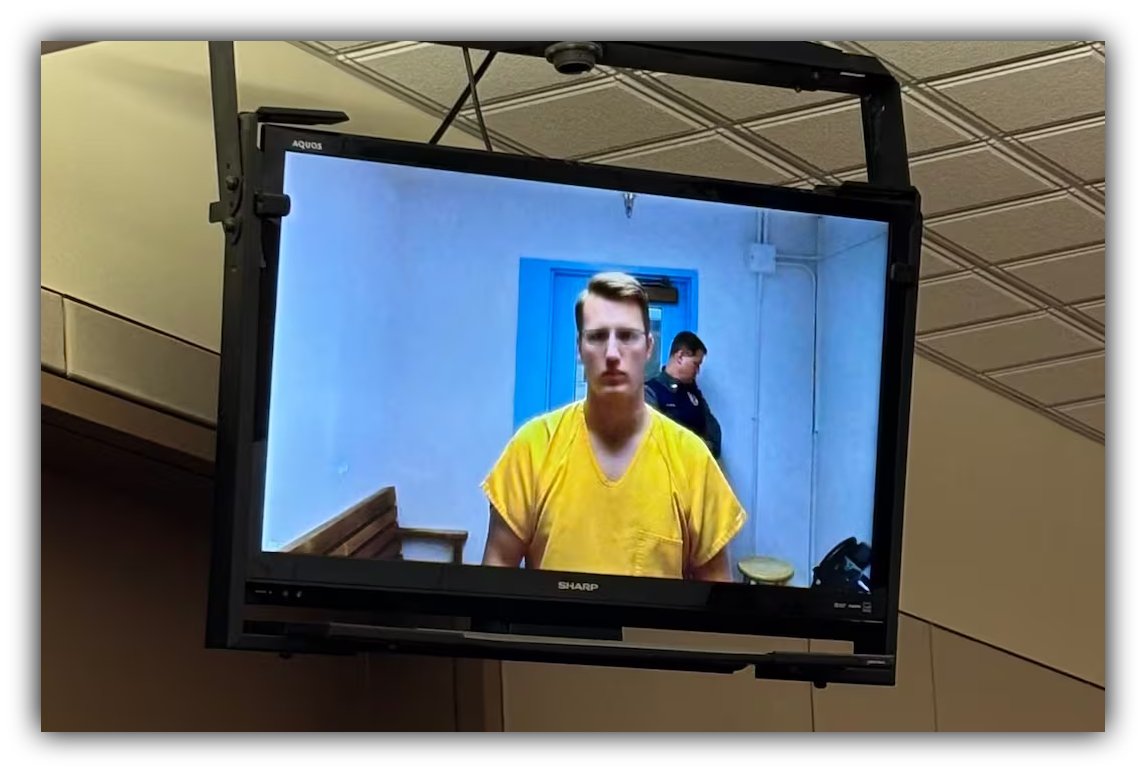
Skyler Evans during his initial federal arraignment in Fairbanks on March 4, 2025. (Haley Lehman/Fairbanks Daily News-Miner)
A federal case in Fairbanks highlights a broader pattern of online grooming, coercion, and abuse across Alaska.
By Gina Hill | Alaska Headline Living | May 1, 2026

The arrest of Skyler Evans on April 29, 2026, a 34-year-old former Fairbanks teacher and former TV news anchor, is the latest federal child exploitation case in Alaska. Prosecutors allege he coerced a minor into sexually explicit conduct to produce abuse material and later possessed additional child sexual abuse material, with conduct spanning from at least 2023 into 2025. He now faces 15 to 30 years in federal prison.
Evans previously worked as an evening news anchor for KTVF in Fairbanks before leaving the station in 2024. He also worked as a teacher in the Fairbanks school system. He was a licensed foster care provider through Alaska’s Office of Children’s Services from June 2021 to November 2022. The allegations now place him in a federal case involving exploitation of a minor, prosecuted through the U.S. Attorney’s Office and the FBI Anchorage Field Office.
This case is not isolated. It is part of a steady stream of federal prosecutions across Alaska involving grooming, coercion, production, and possession of child sexual abuse material.
These cases are not concentrated in one place. They are showing up across Anchorage, Fairbanks, the Mat-Su region, the North Slope, Western Alaska, Southeast Alaska, and Interior communities. Different locations. Same category of crime.
The method is consistent. Contact starts online. It moves into private messages. It escalates through attention, manipulation, secrecy, and pressure. In many cases, minors are coerced into sending explicit material or are directly exploited. The digital trail becomes central to federal prosecution.
These cases often begin in the same environments kids use every day.
- Snapchat
- TikTok
- Roblox
- Fortnite
- Minecraft
- Discord
- Telegram
These are widely used platforms where kids talk, play, and socialize. They also allow private messaging, fast relationship-building, and disappearing conversations, which are exactly the conditions repeatedly present in these cases.

Photo courtesy of the National Center for Missing and Exploited Children.
This is not just an Alaska issue.
Across the country, more child exploitation cases are being uncovered as platforms flag reports and send them to law enforcement. The FBI warns that online grooming and sextortion are rising, especially in spaces where minors can be contacted directly and moved into private channels. As reporting systems improve, more tips and suspected child sexual abuse material are being forwarded to the National Center for Missing and Exploited Children, which routes them to investigators. The result is more cases moving through the system, and a clearer picture of how much of this activity is happening online.
Prevention is still lagging behind detection. Most cases are not stopped at the beginning. They are identified after the contact has already escalated and the harm has already occurred. By that point, investigators are often working backward through chat logs, device data, and platform reports to reconstruct what happened and when the contact turned into exploitation.
That gap is structural.
Alaska makes it sharper. Distance, small communities, and reliance on digital communication mean kids spend more time online to stay connected. That increases exposure to the same environments offenders use to initiate contact.
For parents, warning signs are often behavioral:
- Sudden secrecy around phones, apps, or messages
- Conversations moving into private or disappearing chats
- Unusually intense attention from an online “friend”
- Defensiveness or anxiety about device use
- Withdrawal from family or friends
- Fear of getting in trouble for what is happening online
Grooming does not start with force. It starts with attention, builds through repetition and trust, then shifts into secrecy, pressure, and control.
Long-term effects can be severe. Children may experience anxiety, shame, withdrawal, and difficulty trusting their own judgment. Some struggle with boundaries and relationships long after the contact ends. Others require ongoing mental health support.
If something feels wrong:
- Save messages, usernames, and screenshots
- Talk without blame so the child stays engaged
- Report through platform safety tools or law enforcement
- Contact the National Center for Missing and Exploited Children CyberTipline or 1-800-843-5678
- Call 911 in an emergency or active situation
For parents, kids are not safe online without active guidance. Silence allows these situations to grow. Open conversations and regular check-ins are what interrupt that pattern before it escalates. These are the weak points in the system that determine whether cases are stopped early or allowed to develop.
The Evans case is one file in that system. The rest are still unfolding across Alaska.

For parents, Alaska State Troopers provide an interactive sex offender registry map showing registered offenders in communities across the state.
Sources
U.S. Attorney’s Office, District of Alaska press release (April 30, 2026)
FBI Anchorage Field Office public statements
Alaska Department of Public Safety, Sex Offender Registry Map
National Center for Missing and Exploited Children (CyberTipline and educational resources)
Federal reporting on child exploitation investigations and online safety enforcement trends
What do you feel about this post?

Like

Love

Happy

Haha

Sad