







The Art of Outlasting a Tantrum in a Neck Tie
Donald Trump and Kristen Welker during a tense exchange in Wisconsin as questions over election integrity and evidence are raised during the interview.
Image courtesy: Meet the Press
He’s not trying to answer the question. He’s trying to blow past it.
By Gina Hill | Alaska Headline Living | June 9, 2026
There is a certain kind of powerful bully who does not want a conversation. He wants a performance. He points a finger, raises his voice, questions your integrity, and acts as though sheer volume can replace facts. The goal is simple: make you flinch, make you defend yourself, and make the whole room revolve around his mood.
That is why the composure shown by journalists like Kristen Welker and Kaitlan Collins matters so much. They are not just surviving hostile exchanges. They are modeling how to stay steady when someone with power tries to turn humiliation into theater.
Consider Welker’s recent Sunday interview on NBC’s “Meet the Press.” She had to travel all the way to a barn in Chippewa Falls, Wisconsin, at the Trump administration’s request, where the interview was repeatedly interrupted by rain pounding the metal roof. When she pressed Trump on baseless claims of election fraud in California’s primary races and his false assertion that the 2020 election was “rigged,” he grew visibly agitated. He called NBC a “one-sided crooked network,” told Welker she was from a “dishonest press,” then ripped off his microphone, dropped it to the ground, stepped on it, and walked out. Welker pleaded with him to continue, saying “I traveled all the way to Wisconsin” and “I sat in the rain with you for an hour.” He refused.
When a powerful person lashes out, he is usually trying to avoid the question he does not want to answer. The insult is not a sign of strength. It is an escape hatch. The louder he gets, the more likely it is that the reporter has hit something he cannot explain.
The first rule is simple: do not confuse volume with power. A loud, rude, finger-pointing person can seem overwhelming in the moment, but noise does not equal authority. In fact, the opposite is often true. When someone stops answering questions and starts attacking the person asking them, he is usually trying to escape the pressure of the question itself.
That is your cue to stay anchored.
Do not chase the insult. Do not get dragged into arguing about your tone, your face, your expression, or your character. If the person says you are crooked, ask for the proof. If he calls you a liar, go back to the facts. If he tries to shame you with a cruel little jab, ignore the bait and repeat the question. The power move is not in the insult. The power move is in not letting the insult change your posture.
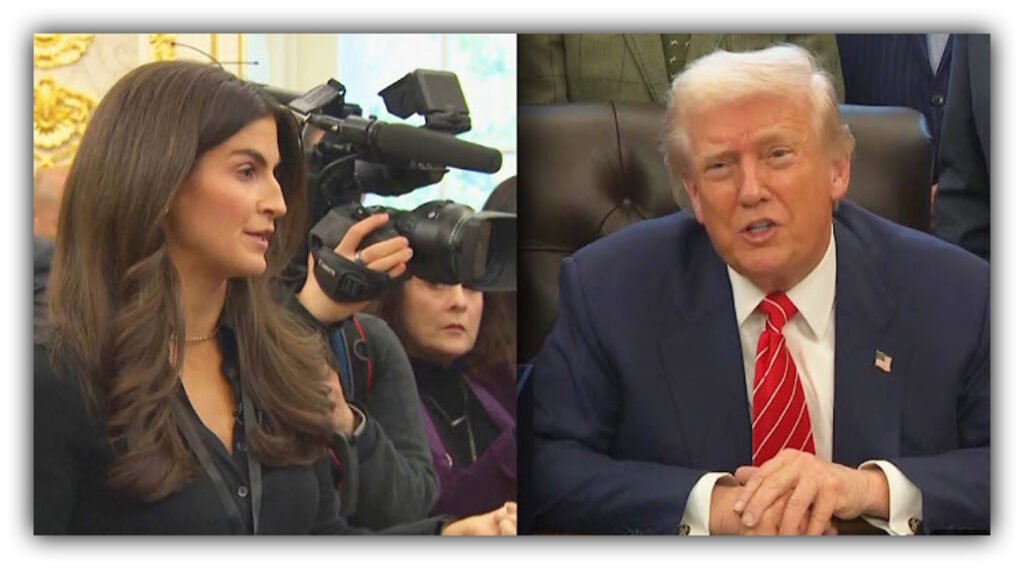
That is especially true with gendered put-downs. When a powerful man tells a female journalist to “smile,” or makes a remark about how she looks, he is not offering style advice. He is trying to assert control. He is saying, in effect, that he gets to decide not only what she asks, but how she should appear while asking it. That is a domination tactic dressed up as a joke.
That is why the “smile” remark to CNN’s Kaitlan Collins was never about smiling. It was about control. He was trying to shrink her, to recast a hard question as a personality flaw. The stronger response is to keep asking the question anyway.
The answer is not to perform ease. The answer is to refuse the script.
One way to do that is to give your body a job. Breathe slowly. Relax your shoulders. Keep your voice low and even. Plant your feet. A calm body helps keep a clear mind, especially when someone is trying to rattle you in real time.
Composure isn’t just about looking steady. It keeps your thinking steady.
When you’re not panicked, you can stay focused, process what’s happening, and choose your response instead of flinching on impulse. You do not need to pretend the moment is pleasant. You just need to stay functional inside it.
Another useful strategy is to mentally reframe the encounter. The bully is not exposing your weakness. He is exposing his own. People who are secure do not usually need to humiliate the person asking the question. They answer, clarify, and move on. When they lash out, they are often trying to cover the fact that the question has hit something uncomfortable.
That reframing matters. Instead of thinking, He is overpowering me, think, He is trying to dodge the question. That small shift can keep you from giving away the room.
There is also something powerful in not being surprised by the behavior. If you expect courtesy from a person who has already shown you contempt, you can waste a lot of energy feeling shocked. But if you recognize the pattern early, you can stop personalizing it. The insult is a tactic, not a verdict.

That pattern includes the incident on Air Force One, when President Trump told Bloomberg reporter Catherine Lucey, “Quiet, piggy,” after she asked about the Epstein files. (See video below.) That was not a joke. It was an attempt to shut down a hard question by humiliating the person asking it. Lucey deserves to be named, not reduced to his insult. She is the journalist who asked the question. He is the one who threw the tantrum.
That is what makes journalistic poise so effective. When a reporter stays calm, asks again, and refuses to join the spectacle, the bully’s performance starts to look weak. The room can see what is happening. The louder he gets, the less serious he appears. The calmer the reporter remains, the more the imbalance becomes visible.
And that is the heart of it: Composure is not passivity. It is resistance with a straight face.
If a powerful person points a finger at you and tries to smear you with his own chaos, your job is not to win his tantrum. Your job is to hold the line, keep the facts in the foreground, and refuse to become a character in his emotional drama. Let him have the outburst. Keep the record.
Because in the end, the strongest answer to a tantrum in a neck tie is not panic. It is poise.
Sources
- Harvard Health: “Staying calm in turbulent times” (March 31, 2017)
- HuffPost: “Trump’s ‘Smile’ Comments To Kaitlan Collins Are Grossly Inappropriate” (Feb 4, 2026)
- HuffPost: “3 Words During Trump’s On-Air Meltdown Stuck Out To Experts” (June 8, 2026)
- NPR: “Trump’s attacks on the press often focus on women reporters who challenge him”(June 4, 2026)
- IWMF: “The tumultuous history of Donald Trump and female reporters” (2020)
What do you feel about this post?

Like

Love

Happy

Haha

Sad