





🏛️ SCOTUS Slams Trump Tariffs, Exposes Congress’ Broken Machine: Power Vacuum Alert
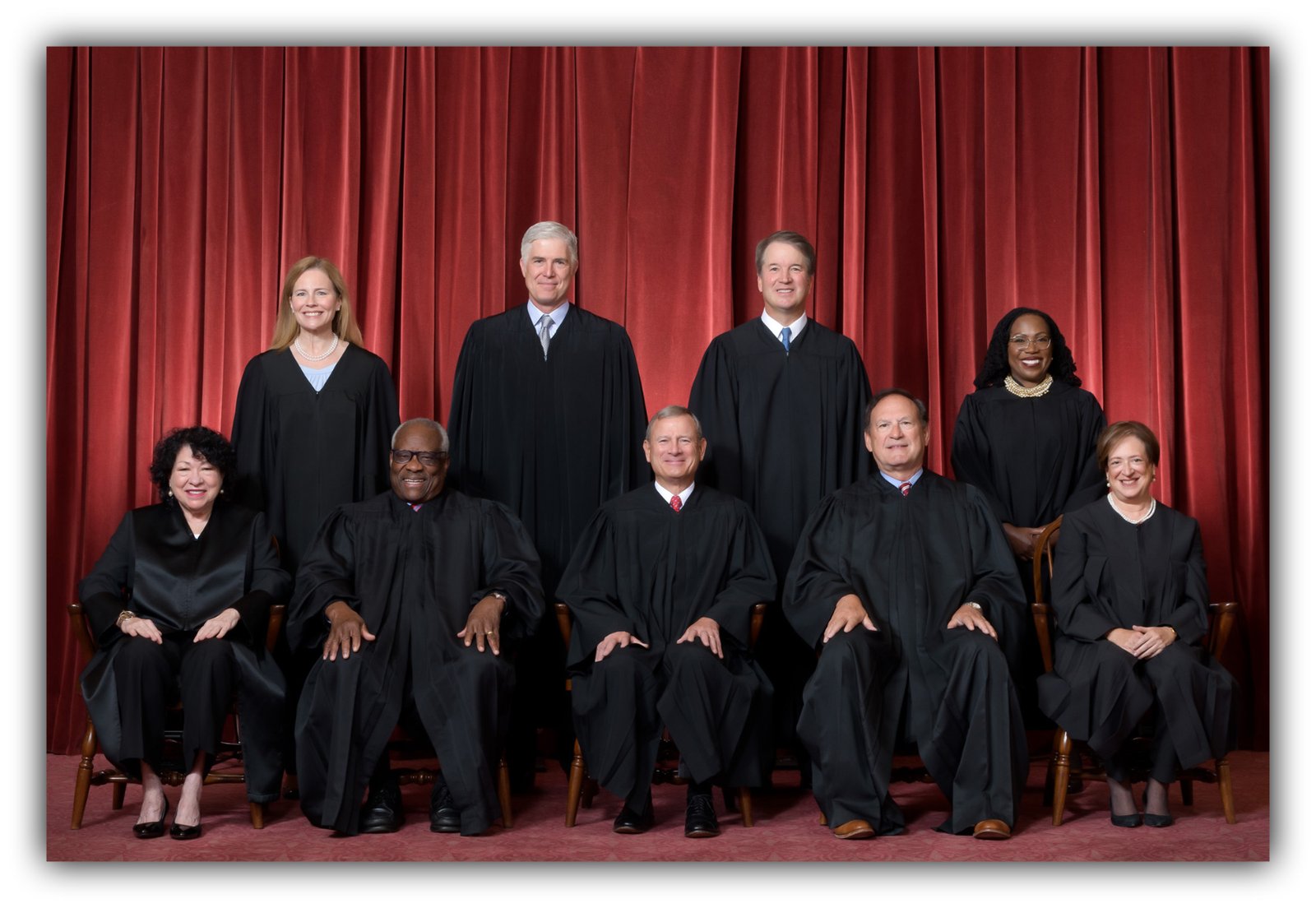
Front row, left to right: Associate Justices Sonia Sotomayor, Clarence Thomas, Chief Justice John G. Roberts, Jr., Associate Justices Samuel A. Alito, Jr. and Elena Kagan. Back row: Associate Justices Amy Coney Barrett, Neil M. Gorsuch, Brett M. Kavanaugh and Ketanji Brown Jackson.
By Gina Hill | Alaska Headline Living | February 2026
WASHINGTON – In a dramatic 6‑3 decision on February 20, 2026, the United States Supreme Court struck down former President Donald Trump’s sweeping global tariffs, ruling they were illegal because he lacked statutory authority to impose them. The ruling exposes a deeper problem in Washington: a paralyzed Congress that has failed to do the fundamental work the Constitution assigns to it.
Chief Justice John Roberts, writing for the majority, emphasized that tariffs are, in essence, taxes and duties, powers that the Constitution expressly grants to Congress. The emergency law Trump relied on, the International Emergency Economic Powers Act of 1977 (IEEPA), does not authorize a president to unilaterally levy broad import taxes.
The ruling carries massive financial implications. Analysts estimate that more than $175 billion in tariff revenue could be at risk of refund to importers if the government must return funds collected under the illegal tariffs. Treasury officials are reportedly preparing for potential refunds, underscoring the economic shockwaves of executive overreach.
Justices Alito, Thomas, and Kavanaugh dissented, arguing that the president’s interpretation of emergency powers was plausible. The majority, however, reaffirmed that only Congress has the authority to impose broad tariffs and taxes.
Trump and the White House Response
As of publication, there has been no formal White House statement responding to the Supreme Court ruling. Former President Donald Trump publicly condemned the decision as “a disgrace” and indicated that he has a backup plan to pursue his tariff policy through alternative means.
Congress in Crisis: Productivity Plummets
The Supreme Court’s decision shines a spotlight on Congress’ failure to legislate on core powers. Without clear laws from the legislature, presidents often attempt to fill the vacuum, stretching statutes and inviting judicial correction, exactly what happened here.
Recent numbers tell the story:
- The 118th Congress (2023–2025) passed only 274 laws, making it one of the least productive in modern history.
- By contrast, the 117th Congress (2021–2023) enacted over 350 laws, closer to historical norms.
- Congress in the 1980s and 1990s routinely passed several hundred laws per session, proving the legislature can function effectively when it prioritizes lawmaking. (understandingcongress.org)
Why the Gridlock Matters
The Constitution divides power deliberately: Congress makes laws, the president enforces them, and the courts interpret them. When Congress abdicates its duty, executive power expands. The Trump tariffs case is a stark example of what happens when Congress fails to legislate clearly on economic policy, forcing the courts to step in.
Tariffs affect American consumers, importers, and global trade partners. Leaving such critical decisions to executive decree undermines accountability and the balance of powers that our government relies on to function properly.
Looking Ahead
The ruling could trigger massive refunds, complex litigation, and additional legal battles as the administration seeks new legal authority for tariffs. More broadly, it serves as a wake-up call to Congress: if lawmakers want presidents to have authority over trade, taxes, or national emergencies, they must grant it explicitly through law, not rely on vague statutes.
Bottom line: the Supreme Court has drawn a line in the sand. Executive power has limits, and Congress cannot continue to shirk its constitutional responsibilities without creating a dangerous imbalance in American governance.
Sources: Official U.S. Supreme Court opinion for Learning Resources, Inc. v. Trump, 607 U.S. ___ (Feb. 20, 2026), available at supremecourt.gov; Supreme Court docket for 24‑1287 at supremecourt.gov; Justia case summary at supreme.justia.com; Cornell Law School bulletin on IEEPA at law.cornell.edu.”
What do you feel about this post?

Like

Love

Happy

Haha

Sad