
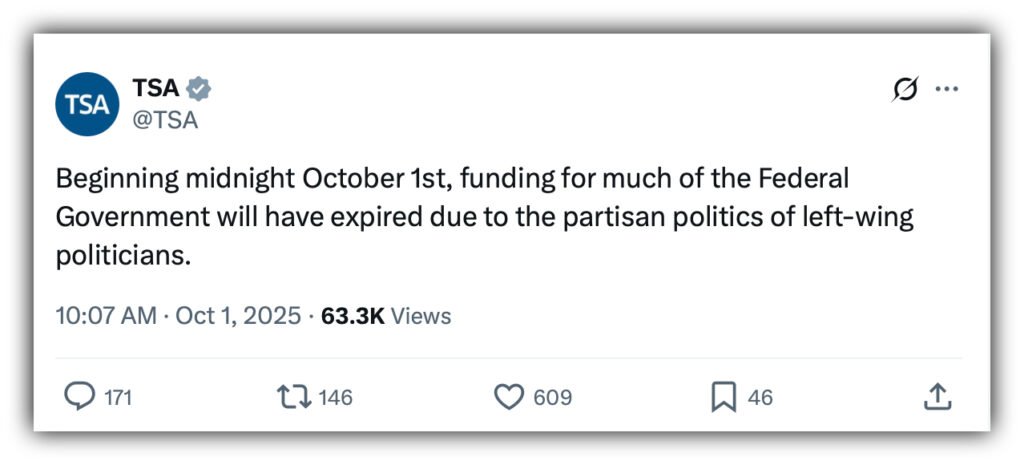
“Beginning midnight October 1st, funding for much of the Federal Government will have expired due to the partisan politics of left-wing politicians. While it is unfortunate some of our politicians have put politics before the well-being of our country, TSA is prepared for an orderly shutdown.” TSA on Facebook and X.
By Gina Hill | Alaska Headline Living | November 2025
As federal employees navigate the line between public service and politics, Americans have tools to hold agencies accountable when government operations drift into partisan messaging.

In early October 2025, the Transportation Security Administration (TSA) sparked controversy with a social media post blaming a specific political party for a federal government shutdown. While the post provided factual information about operations and passenger delays, it also contained overtly partisan language, raising concerns about a potential violation of the Hatch Act—the federal law that limits political activity by government employees.
The Hatch Act exists to preserve the integrity of the federal workforce by prohibiting partisan activity by government employees while on duty, in federal workplaces, or using government resources. Its purpose is simple: federal agencies should serve the public, not political parties. Violations can include endorsing candidates, criticizing political groups, or using official authority to sway elections.
Despite this law, instances of federal agencies engaging in political messaging, intentionally or inadvertently, are not uncommon. When partisan perspectives seep into official communication, it undermines public trust and blurs the line between governance and politics. Posts like the TSA’s, especially when posted on official social media accounts, raise legitimate questions about compliance and accountability.
So, what can concerned citizens do? First, Americans can report Hatch Act violations. The U.S. Office of Special Counsel (OSC) investigates complaints, and individuals, including federal employees and the public, can file reports if they believe partisan activity has occurred in violation of the law.
Second, public pressure matters. Citizens can demand transparency and objectivity from federal agencies, whether through letters to elected representatives, public comment on agency communications, or scrutiny via independent media outlets. The expectation is clear: government resources should inform and protect the public, not advance partisan agendas.
Finally, awareness is key. Understanding what constitutes illegal partisan activity empowers voters to recognize when government messaging crosses the line. By staying informed and engaged, Americans play a direct role in ensuring federal agencies remain neutral, effective, and accountable.
The TSA incident is a reminder that even the most essential agencies are not immune to political influence. The Hatch Act provides a legal boundary, but upholding it requires vigilance, from federal watchdogs and, critically, the citizens they serve.
Report a Hatch Act Violation
U.S. Office of Special Counsel (OSC) – the independent federal agency that enforces the Hatch Act.
Online Complaint Form:
https://osc.gov/Services/Complaint-Process/Pages/Hatch-Act.aspx
Mailing Address:
U.S. Office of Special Counsel
1730 M Street NW, Suite 218
Washington, DC 20036
Phone:
1-800-854-2824 (toll-free)
Email:
OSC_HatchAct@osc.gov
Citizens can submit complaints anonymously if desired, though providing contact info can help OSC investigate more thoroughly.