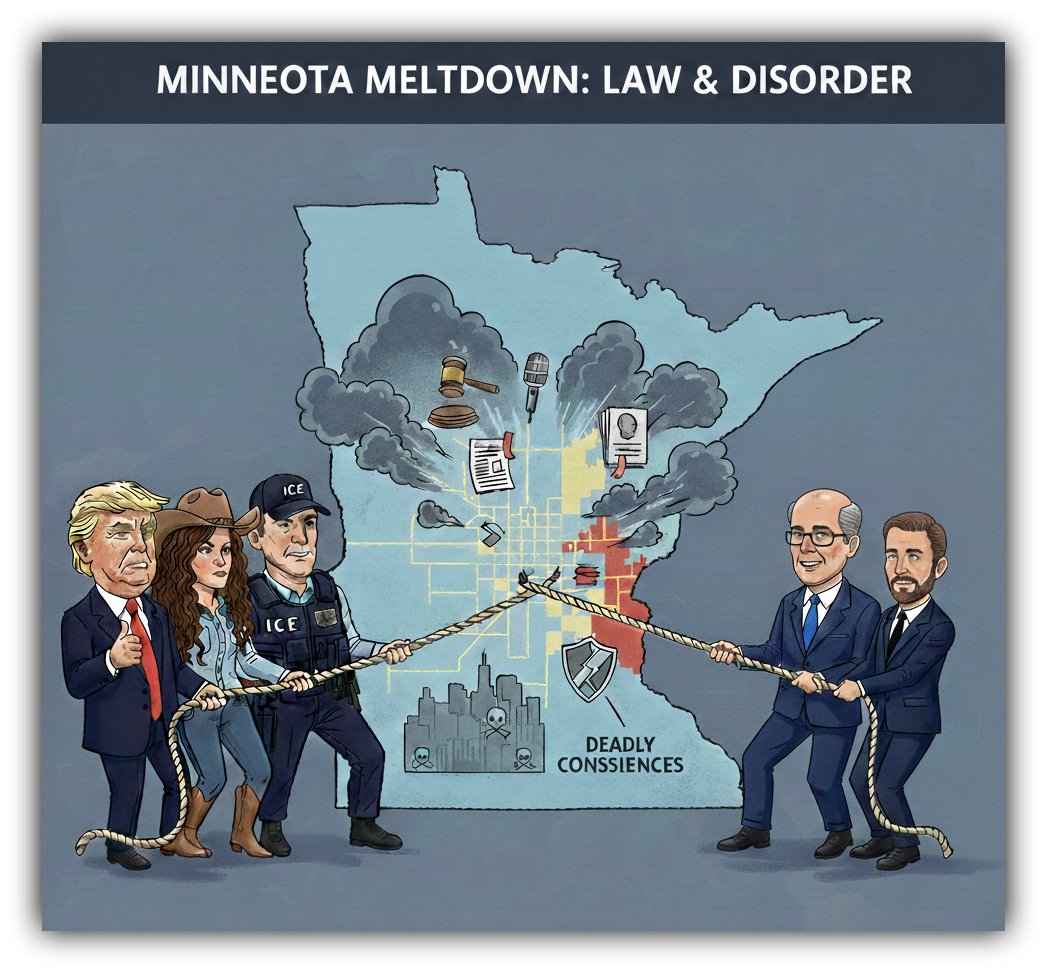
Minnesota has become the focal point of a widening legal dispute over federal immigration enforcement, as ICE operations, court-ordered limits on agent conduct, and a DOJ investigation into state and local leaders raise unresolved questions about First Amendment protections, selective enforcement, and the constitutional limits of federal power.
Source: Alaska Headline Living ©️
By Gina Hill | Alaska Headline Living | January 2026
The Legal Question at the Center
When federal immigration enforcement triggers protests and public criticism by elected officials, and the Department of Justice responds by opening a criminal investigation into those officials, the question is not political preference. The question is constitutional law.
Specifically, where is the legal boundary between lawful federal enforcement and unconstitutional retaliation against protected political speech?
Minnesota has become the testing ground for that question.
Federal Authority Over immigration
The federal government has broad and well established authority over immigration enforcement. Under Article I and long standing Supreme Court precedent, immigration is a federal function, and federal agents may operate anywhere in the United States without state approval.
States may not block or nullify federal immigration law. They may, however, decline to assist federal enforcement and may criticize it publicly. That distinction matters.
The ICE Enforcement Surge and Resulting Litigation
Federal authorities have launched one of the largest immigration enforcement operations in Minnesota in years. The operation has led to thousands of arrests and significant public backlash.

Legal consequences have followed. A fatal shooting involving an ICE agent prompted protests. A federal judge has since imposed limits on how immigration agents may interact with protesters. The ACLU has filed suit alleging racial profiling and unlawful arrests. These cases are pending and unresolved.
At this stage, courts are not evaluating the wisdom of immigration policy. They are evaluating whether federal agents have complied with constitutional constraints, including the First and Fourth Amendments.
What the DOJ Investigation Alleges
The Department of Justice has confirmed a criminal investigation into Minnesota Governor Tim Walz and Minneapolis Mayor Jacob Frey. The inquiry centers on whether their public statements criticizing federal enforcement constituted a conspiracy to impede federal officers.

(Official White House Photo by Molly Riley)
The statute implicated, 18 U.S.C. § 372, criminalizes conspiracies to prevent federal officers from performing their duties through force, intimidation, or threats.
This is a critical limitation. The statute does not criminalize opposition, protest, or criticism. It criminalizes coercive interference.
As of now, no charges have been filed and no public evidence has been presented showing threats, coordination of violence, or directives to obstruct federal agents.
First Amendment Protections and the Governing Test

Political speech is at the core of First Amendment protection. The Supreme Court has repeatedly held that speech becomes criminal only when it is intended, likely, and imminent in producing unlawful action. This standard originates in Brandenburg v. Ohio and remains controlling law.
Under this framework, public officials may criticize federal policy, warn constituents, and express opposition without fear of criminal liability. The law draws a sharp line between advocacy and incitement.
Crossing that line requires evidence of intent to cause unlawful action and a realistic likelihood that such action will occur immediately.
The January 6 Comparison as a Legal Benchmark

Courtesy of: Aca1291
The January 6 cases provide a useful constitutional comparator because courts have already applied this standard to presidential speech.
Donald Trump was not investigated or charged solely for rhetoric. Courts examined the totality of his conduct. They emphasized that he knowingly spread false claims, summoned supporters to Washington on the day of electoral certification, directed them to the Capitol, and failed to intervene once violence began.

Judges have ruled that this combination plausibly constituted incitement and aid to unlawful action. That is why civil liability has survived dismissal and why criminal charges were brought.
The key legal point is not the content of speech alone. It is intent, coordination, and foreseeable consequences.
Application to Gov. Walz and Mayor Frey
Based on publicly available information, Walz and Frey criticized federal enforcement and urged lawful resistance and caution. There is no public evidence that they directed violence, coordinated threats, or encouraged imminent unlawful action against federal officers.
Absent such evidence, their speech remains protected under the First Amendment. If criticism alone can be reframed as intimidation, the constitutional standard collapses.

Selective Enforcement Concerns
The Constitution does not prohibit investigations of public officials. It does prohibit the use of criminal law to punish protected speech.
Selective enforcement becomes a constitutional problem when similarly situated conduct is treated differently based on viewpoint or political alignment. If speech that is less direct and less connected to unlawful action is investigated while more extreme conduct is defended or minimized, courts will scrutinize motive and application.
This is not a rhetorical concern. Courts have invalidated prosecutions where the appearance of retaliation undermines constitutional protections.
Is Minnesota Under Siege
Legally, no. Federal immigration enforcement is lawful in Minnesota. Federal presence alone does not constitute a constitutional violation. Civically, however, courts recognize that intimidation can occur without physical occupation. The chilling effect of investigations into speech is a recognized First Amendment harm. The question courts will ultimately decide is whether federal actions here were narrowly tailored to enforce the law or broadly deployed in a way that suppresses dissent.
Conclusion
This dispute is not fundamentally about immigration. It is about constitutional limits.
The DOJ can investigate obstruction where there is evidence of threats, force, or coordination. It cannot criminalize political criticism without violating the First Amendment. Courts have already found that Trump’s January 6 conduct plausibly exceeded protected speech. By contrast, the publicly known conduct of Walz and Frey has not.
Whether the DOJ can justify this investigation within constitutional bounds will determine not just its legality, but its legitimacy. This is not about immigration alone. It is about whether political opposition can exist safely in America.
That determination belongs to the courts. 🏛️