
The Threads post which helped spark a wave of backlash and ridicule online.
By Gina Hill | Alaska Headline Living | December 2025
Social media posts about tampons in men’s restrooms at airports, schools, and other public places have become a potent new flashpoint in the wider culture war over transgender rights and visibility. These images are often real, but the way they are framed is carefully designed to provoke anger, fear, or ridicule among people who already feel uneasy about “trans anything.”
Weaponizing a stainless steel box
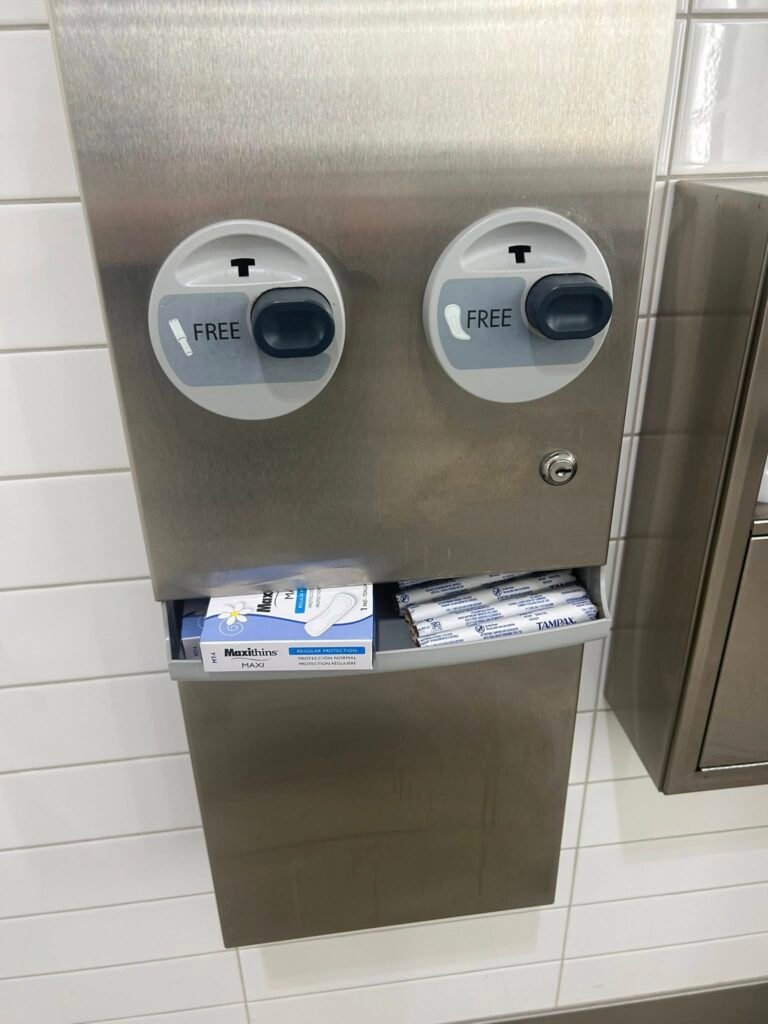
Many of these viral posts follow the same script. A photo shows a free tampon or pad dispenser in a men’s restroom, accompanied by a caption implying that officials “can’t tell male from female anymore” or that society has lost touch with reality. The narrator often adopts a tone of exasperation—“Look what the woke left is doing now”—and invites followers to mock the idea that anyone in a men’s restroom could need menstrual products, while omitting the fact that trans men, nonbinary people, and some intersex people do menstruate and may use those spaces. The nuance of why the dispenser is there—serving those users or simply expanding access—is deliberately erased in favor of a clean, outrage‑friendly narrative.
Centering the main clapback
One reply that quickly became the thread’s north star came from user @im_bitchwizard, who contrasted a metal dispenser with the daily realities of misogyny and transphobia.
“Did the machine make you a second class citizen, take away your bodily autonomy, and tell you to smile more?” they asked, before escalating the comparison: “Did it cat‑call you until it saw your neck pussy, call you a slur and beat you within an inch of your life? Did it criminalize your existence, erase your identity and demoralize you?” – @im_bitchwizard
The commenter closed with a reminder that the public sphere is already saturated with male‑oriented sexual marketing: “If we have to hear ads for boner pills literally everywhere in the U.S. I think you can shut the fuck up about a stainless steel box. Also, did you wash your hands?” In a few scorching sentences, the reply reframed the entire debate: the problem is not a box of pads, but the disproportionate fury directed at any accommodation for people who aren’t cisgender men.
How the clapback caught fire
The clapback did not just land; it ignited. “I’m still laughing at that random ‘Also, did you wash your hands’,” wrote @laurenknight13. “You sound like a mother teaching her child. Wish it would work on misogynistic dingbats like this.” Another user, @charlieneiss, argued that the outrage was less about a dispenser and more about a perceived loss of power: “He probably sees it as an infringement of his desire to make others (women) second class citizens, take away their bodily autonomy… In other words, he’s a fragile male who’s insecure about his own masculinity – a true snowflake.” For @afernuik, the incident fit a familiar pattern: “You spit out willfully ignorant hate first, get pushback, and then play the victim. Doesn’t your generation ever get sick of this game?” Together, these responses turned the original post on its head, casting the would‑be cultural critic as an example of the grievance politics he claimed to oppose.
Outrage as a political tool
This dynamic is not confined to one airport or one thread. A local decision to stock menstrual products, framed by officials as a mundane public‑health measure, can be spun into evidence of a supposed national conspiracy to erase gender distinctions. Influential accounts recycle the same visual—a tampon dispenser in a men’s room—across platforms with increasingly inflammatory captions, using the image as shorthand for everything their audiences fear about social change. The result is a feedback loop in which each new photo is less about bathrooms and more about mobilizing voters, selling a brand, or reinforcing an identity built around feeling besieged by “wokeness.”
Who pays the price
For transgender and nonbinary people, these manufactured firestorms are not abstract. A policy meant to ensure they can manage a basic bodily function without shame becomes a spectacle in which their needs are mocked as absurd or illegitimate. The message is that even small gestures toward inclusion are intolerable, and that any attempt to make public space more hospitable to them will be punished with ridicule and backlash. By foregrounding voices like @im_bitchwizard and the users who rallied behind that clapback, the thread offers a counter‑narrative: one that refuses to accept that kindness, access, and bodily autonomy are up for debate every time someone posts a picture of a stainless steel box.