By Gina Hill | Alaska Headline Living | January 2026
SACRAMENTO – Governor Gavin Newsom rejects Louisiana’s request to extradite a California physician accused of providing medication abortion care that is legal under California law, invoking his authority to deny the request.
In a statement released by the Governor’s Office, Newsom said the request crossed a line by attempting to punish medical providers for care that is lawful in California.
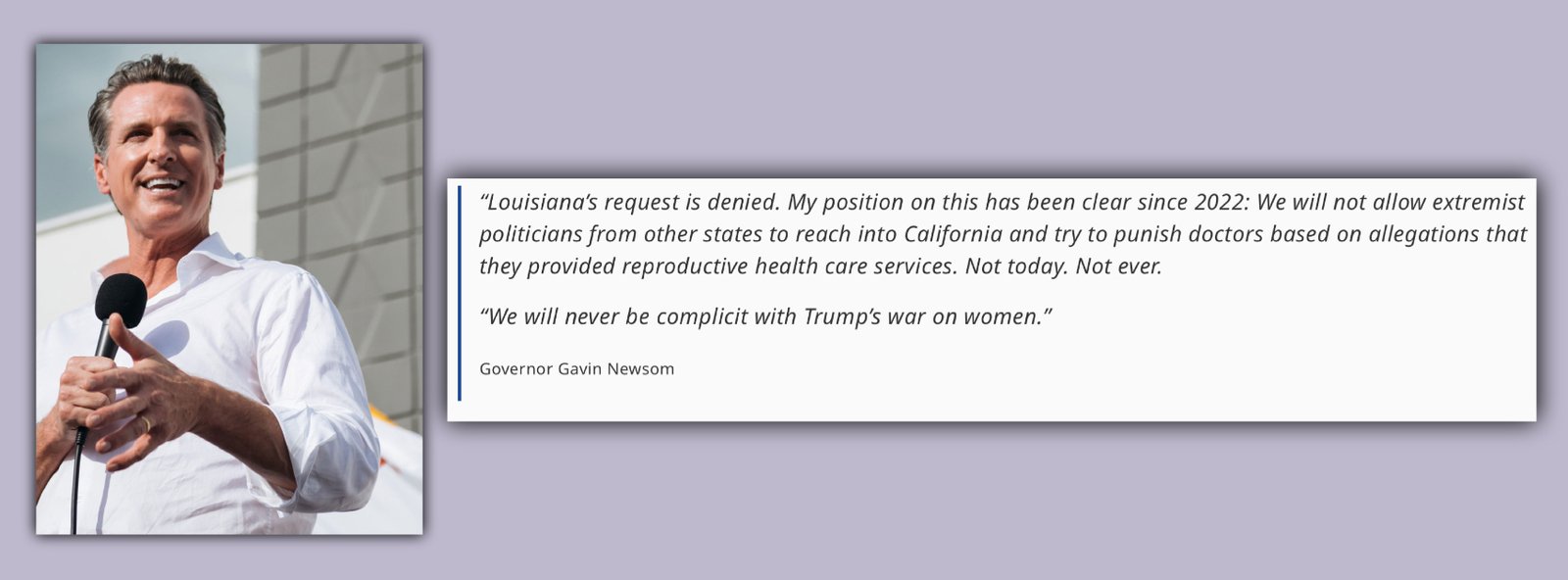
“Louisiana’s request is denied,” Newsom said. “My position on this has been clear since 2022. We will not allow extremist politicians from other states to reach into California and try to punish doctors based on allegations that they provided reproductive health care services. Not today. Not ever.”
Newsom added, “We will never be complicit with Trump’s war on women.”
The Governor’s Office said the decision is consistent with Executive Order N-12-22, which directs California to decline extradition requests from other states seeking to prosecute individuals for providing, receiving, or assisting with reproductive health care that is legal in California. Under federal and state law, governors retain discretion to reject extradition requests in cases where the alleged conduct occurred within their state’s borders.
State officials also emphasized that the charges filed in Louisiana are allegations only and that defendants are presumed innocent unless proven guilty beyond a reasonable doubt.
California’s Actions to Protect Reproductive Freedom
Since the U.S. Supreme Court’s Dobbs v. Jackson decision overturning Roe v. Wade, California has expanded legal and practical protections for abortion access and reproductive health care.
In September 2025, Newsom signed legislation aimed at safeguarding access to reproductive care, including AB 260 by Assemblymember Cecilia Aguiar-Curry. The law allows providers to prescribe abortion medication anonymously, requires California regulated health plans to cover mifepristone regardless of federal approval status, and strengthens legal protections for providers against criminal prosecution and civil actions related to medication abortion.
The 2025–26 state budget, approved in June 2025, expanded the authority of CalRx to purchase brand name drugs. State officials said the move was designed to counter supply chain disruptions, market manipulation, or politically motivated restrictions that could limit access to essential medications, including those used for abortion care.
In May 2024, Newsom signed SB 233, authored by Aguiar-Curry and Senator Nancy Skinner, allowing Arizona abortion providers to temporarily offer care in California after the Arizona Supreme Court revived an 1864 law imposing a near total abortion ban.
Earlier efforts included the state’s participation in a U.S. Supreme Court case defending the FDA’s approval of mifepristone, the creation of an emergency stockpile of misoprostol in 2023, and coordination with other governors to pressure pharmacies to maintain access to abortion medications.
California voters also approved Proposition 1 in November 2022, amending the state constitution to protect reproductive freedom, including abortion and contraception. That same year, Newsom launched Abortion.CA.Gov and signed what his office described as the largest reproductive freedom legislative package in state history, along with an executive order protecting health data and rejecting out-of-state extradition requests tied to abortion care.
The Governor’s Office said Tuesday’s decision reflects California’s continued stance that reproductive health care decisions should remain between patients and providers, free from interference by other states.