
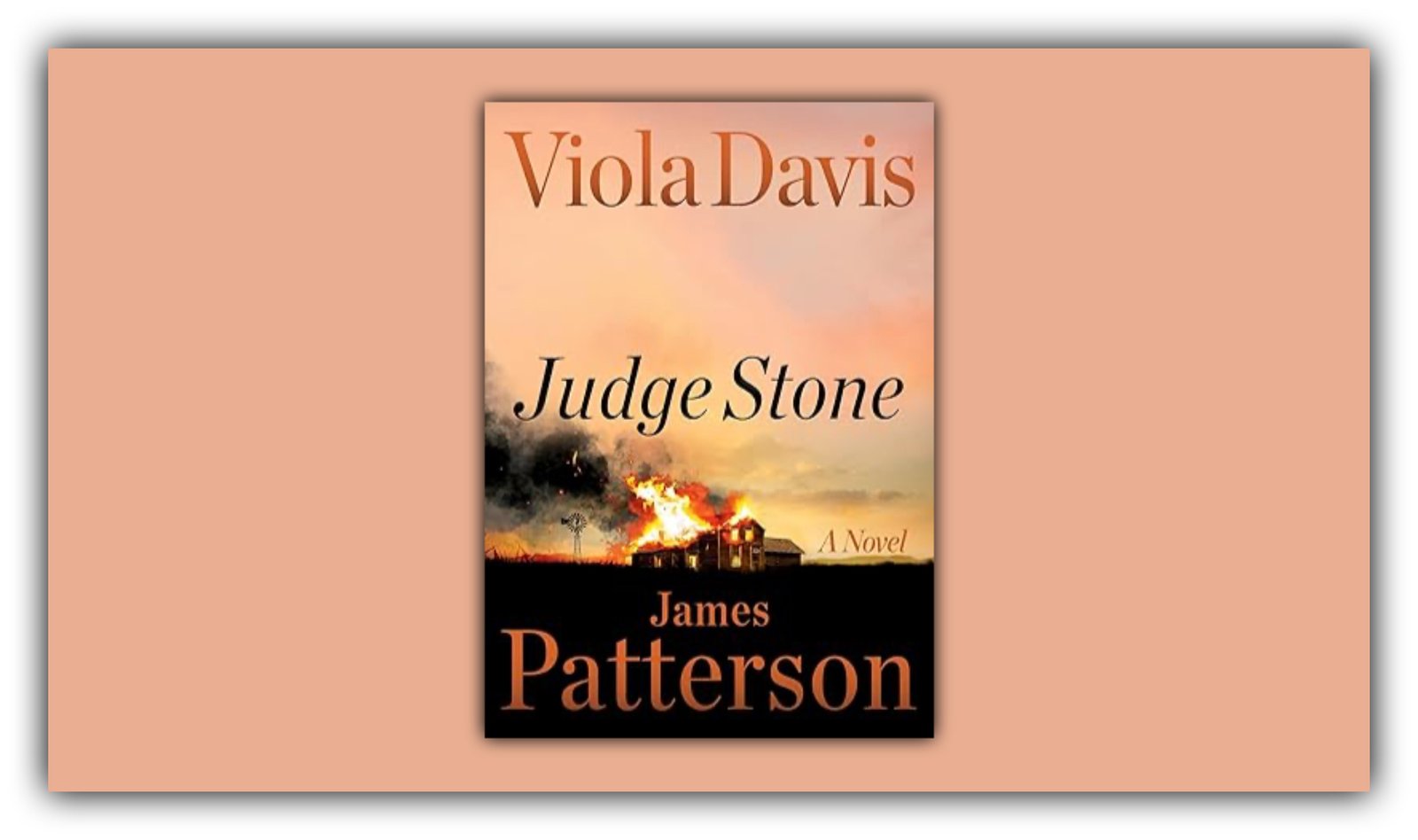
Exploring justice, community, and the making of Judge Stone: A Novel. A collaboration between James Patterson and Viola Davis that blends courtroom suspense with human truth.
By Gina Hill | Alaska Headline Living | March 2026
Anticipation is swirling around Judge Stone: A Novel, the collaboration between James Patterson and Viola Davis. The novel represents an unusual pairing of commercial thriller pacing and character-centered moral storytelling, aiming to place courtroom tension inside a broader reflection on justice and community.
The story centers on Judge Mary Stone, portrayed as the first Black woman to serve as a circuit judge in her county in Alabama. This detail is more than biographical backdrop; it shapes the character’s public role and private burden. Judge Stone is responsible not only for interpreting law but also for representing a historical milestone in a community where public authority carries memory as well as obligation. Outside the courthouse, she helps manage a family farm, reinforcing the novel’s theme that justice does not exist separate from everyday life.
The central case involves a physician charged under strict state abortion statutes after treating a thirteen-year-old girl. Promotional material describes the conflict as criminally straightforward but morally unresolved, framing the narrative less as a trial procedural and more as an ethical examination of law’s limits. The premise reflects a tradition of Southern legal fiction in which courtroom decisions function as social events as much as legal outcomes.
Patterson shapes the narrative with fast-moving suspense, using sharp dialogue and escalating courtroom pressure to maintain momentum. The structure resembles a witness being called unexpectedly to testify, where information is revealed in controlled but accelerating increments. Davis contributes emotional authenticity to the protagonist’s perspective, presenting Judge Stone as a figure of judicial authority who remains deeply aware of the human consequences behind every ruling.
The novel’s small-town Southern setting functions almost as a secondary character. In a community where courthouse steps serve as informal meeting grounds, justice extends beyond legal procedure. Rulings are portrayed as events that follow the judge into everyday spaces: farm fields, family discussions, and quiet evenings where professional responsibility meets personal reflection.
Rather than emphasizing technical legal mechanics, the story appears to focus on moral tension. The space between statute and conscience becomes the central narrative terrain. Courtroom objections are framed symbolically, representing the broader social and ethical conflicts surrounding the case. Each decision from the bench carries not only legal meaning but civic and emotional consequence.
The townspeople watching from the gallery are described as a living reflection of public judgment, illustrating the social complexity faced by public officials in closely connected communities. The novel suggests that justice in such a setting is never fully contained within the courthouse walls.
Readers can purchase the book beginning March 9, 2026 through the official publisher listing at Little, Brown and Company and major retailers including Amazon. The hardcover edition is priced at $32.00, the ebook at $14.99, the unabridged audiobook download at $27.99, and the large print trade paperback at $34.00. The novel spans approximately 432 pages and carries ISBN-13 9780316579834. Preorders are available now, with automatic Kindle delivery scheduled for release day, and distribution is expected through additional booksellers such as Barnes & Noble, Books-A-Million, Bookshop, Target, and Walmart.

At its core, the collaboration between Patterson and Davis appears to aim for a legal thriller that moves quickly but asks readers to sit with uncertainty. The story does not present justice as a final declaration, but as a continuing conversation shaped by community history, personal conscience, and the cost of choice.
All rise. Court is in session.