







Begich Backs Murkowski in Bipartisan Fight Against Federal Election Overreach
By Gina Hill | Alaska Headline Living | February 2026
In a rare bipartisan alignment, former state senator Tom Begich is backing U.S. Sen. Lisa Murkowski’s opposition to what both describe as federal overreach into state-run elections.
“I stand in agreement with Sen. Murkowski against federal election overreach,” Begich wrote on social media.
He criticized efforts by the Trump Administration to control states’ election systems, calling them wrong and arguing that the U.S. Constitution protects states’ authority over elections.
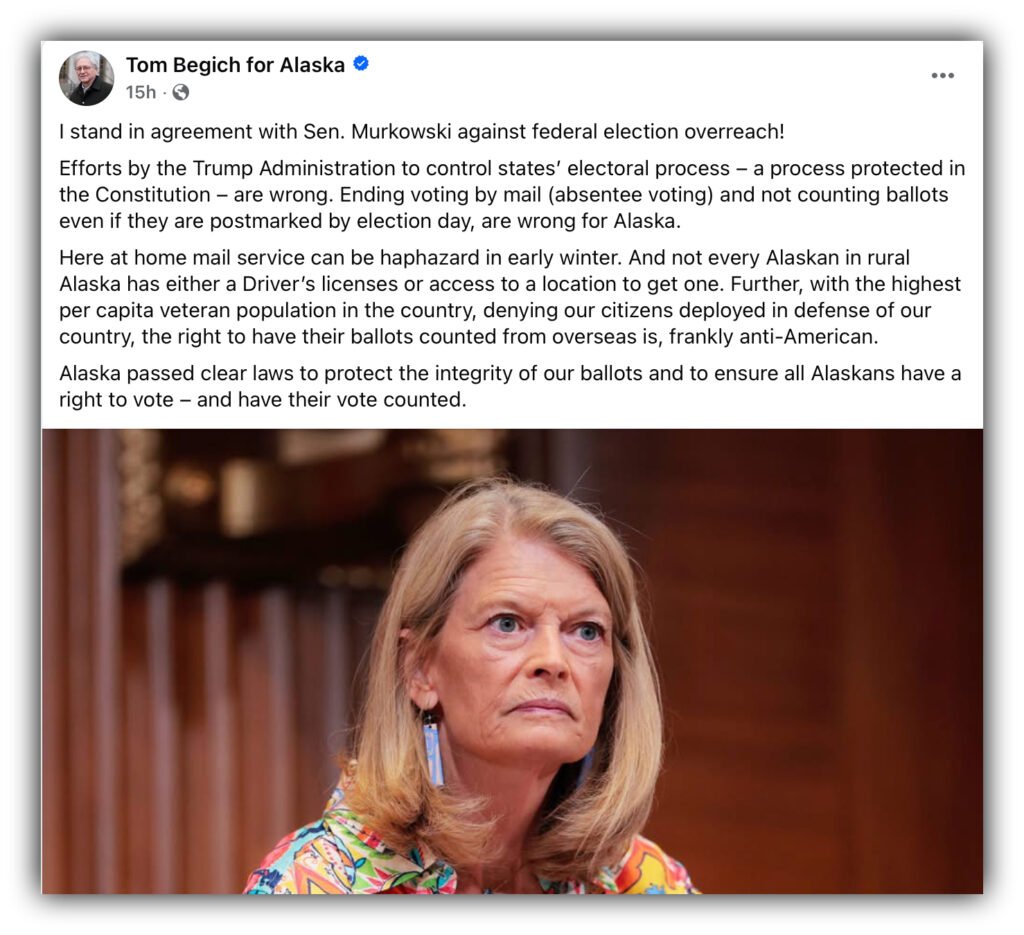
Begich specifically pointed to proposals that would end voting by mail and prevent ballots from being counted if they are not received by Election Day, even if postmarked on time. He said such changes would disproportionately affect Alaska, where mail service can be unpredictable in early winter. He also noted that not every rural Alaskan has easy access to a driver’s license, and that Alaska’s high per capita veteran population makes counting overseas ballots especially important.
Murkowski echoed similar concerns in her own statement about federal election legislation.
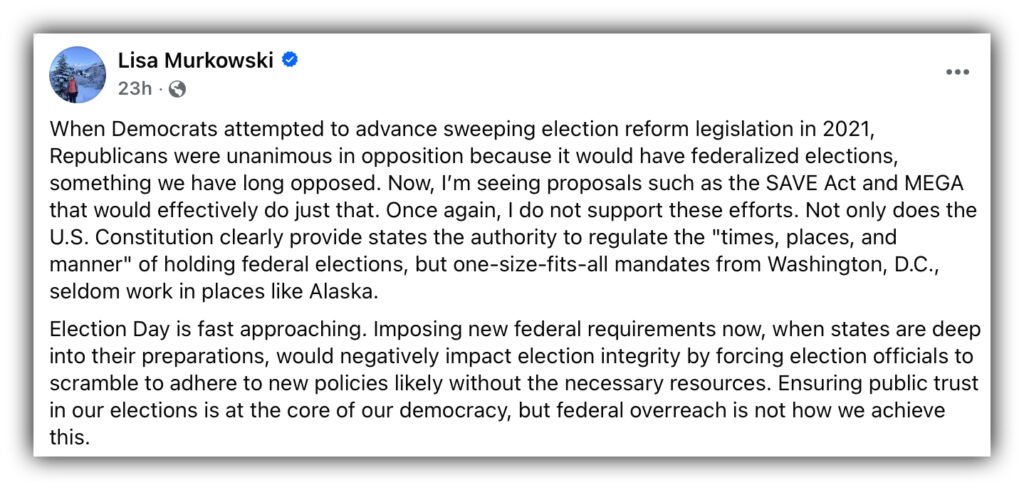
“When Democrats attempted to advance sweeping election reform legislation in 2021, Republicans were unanimous in opposition because it would have federalized elections, something we have long opposed,” Murkowski wrote. “Now, I’m seeing proposals such as the SAVE Act and MEGA that would effectively do just that. Once again, I do not support these efforts.”
To clarify Murkowski’s reference, reporting by CNBC shows that the 2021 Democratic-backed For the People Act was a sweeping election and ethics reform bill that would have expanded automatic voter registration, expanded early voting, and set uniform election standards nationwide, but it failed in the Senate after Republican senators blocked debate on it, arguing it would centralize control of elections in Washington.
On the current proposals, the Safeguard American Voter Eligibility (SAVE) Act would require documentary proof of U.S. citizenship to register to vote in federal elections and tighten verification requirements for mail-in registration, and the Make Elections Great Again (MEGA) Act, introduced by House Republicans, would go further by establishing baseline requirements such as national voter ID and clean voter rolls as part of a broad election reform package.
Murkowski emphasized that the Constitution grants states the authority to regulate the “times, places, and manner” of federal elections. She warned that one-size-fits-all mandates from Washington, D.C. are unlikely to work in Alaska’s unique environment.
“Ensuring public trust in our elections is at the core of our democracy, but federal overreach is not how we achieve this,” Murkowski wrote.
The statements mark a rare moment of bipartisan agreement in Alaska over state control of elections. With Election Day approaching and Tom Begich running for governor, the spotlight is on how both lawmakers and election officials will navigate federal proposals like the SAVE and MEGA acts while ensuring Alaskans’ votes are counted. The debate could shape voter confidence, influence campaign messaging, and set a tone for Alaska’s election rules in the years ahead.
Alaskans can make their voices heard by staying informed on proposed legislation, contacting their elected officials, and participating in public hearings or town halls.
What do you feel about this post?

Like

Love

Happy

Haha

Sad