










Federal Smuggling Case in Tennessee: What Comes Next for Kilmar Abrego Garcia?
Kilmar Abrego Garcia stands outside Greenbelt federal court with his wife and a CASA advocate after a judge allowed him to remain free while reviewing his vindictive prosecution claim.
Photo: William J. Ford/Maryland Matters
By Gina Hill | Alaska Headline Living | December 2025
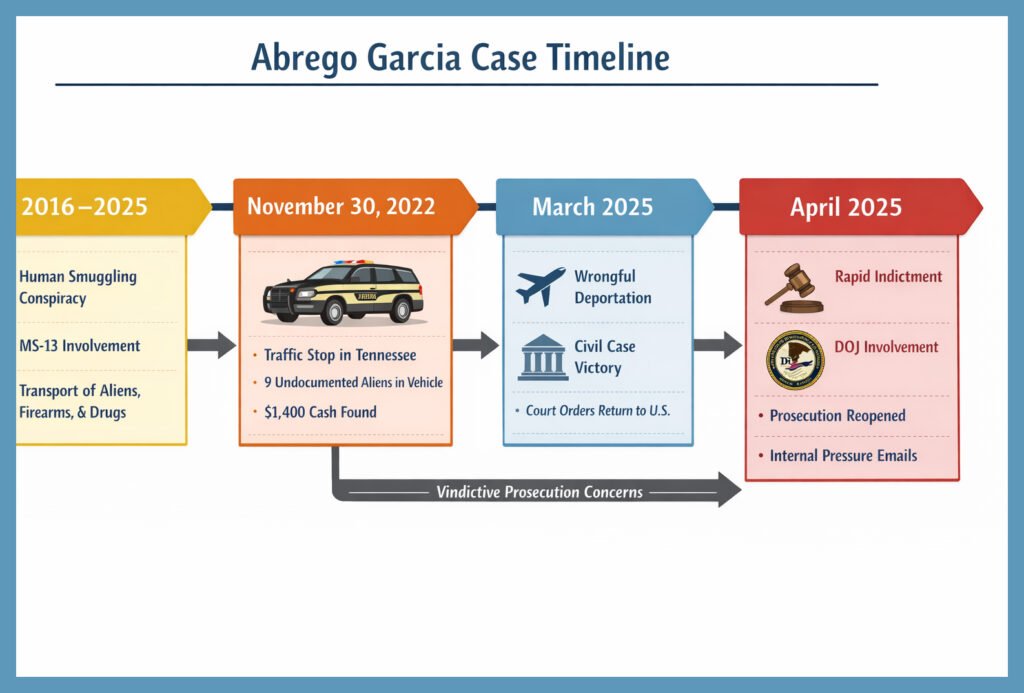
Kilmar Abrego Garcia was wrongfully deported to El Salvador in March 2025 even though a judge had previously ruled he could not be sent back there. After legal fights in federal court and the U.S. Supreme Court, he was returned to the United States. Shortly after his return, federal prosecutors filed smuggling charges against him in Tennessee. He has not been convicted of any crime.
As of December 2025, he is living at home in Maryland with his wife and family, free from custody under court orders that prevent Immigration and Customs Enforcement (ICE) from detaining him again for now. His next major court date is January 28, 2026, when a federal judge will hear arguments about whether the human smuggling charges in Tennessee should continue.
Below is a timeline of key events in the case:
Who Is Abrego Garcia?
Abrego Garcia is a citizen of El Salvador who has lived in the United States for most of his life. He arrived around 2011 as a teenager and has lived in Maryland with his family for over a decade before his wrongful deportation in March 2025.
Prosecutors allege that he is connected to the gang MS-13, and that co-conspirators are mostly foreign nationals, some of whom, they say, are also connected to MS-13.
What Is He Charged With?
Abrego Garcia is charged with conspiracy to transport people without permission. Prosecutors say he and others planned to move people into and across the United States without legal authorization and collected money for these activities.
He is also charged with unlawful transportation of people without permission, which involves helping move people who were already in the United States illegally.
Abrego Garcia has pleaded not guilty to all charges. If he is convicted, the government could seize vehicles, money, or other property used in the alleged crimes.
Source: Indictment, U.S. District Court, Middle District of Tennessee
Representative Event: Tennessee Traffic Stop

On November 30, 2022, Abrego Garcia was driving a Chevrolet Suburban in Tennessee. Nine passengers were undocumented, had no IDs or luggage, and the vehicle had extra installed seats. Abrego Garcia carried $1,400 in cash. Prosecutors say that troopers released him and that he then informed co-conspirators about the stop afterward.
Source: United States v. Abrego Garcia, Indictment and case filings (PDF and docket) via CourtListener.
Vindictive Prosecution Questions

Abrego Garcia’s wrongful deportation in March 2025 led to a civil lawsuit and his eventual return to the United States. Soon after his return, federal prosecutors filed the smuggling charges. A judge noted there is a realistic chance the prosecution could be seen as retaliatory and allowed discovery and a hearing on this issue. For example, the court will consider questions such as whether the timing of the charges related to Abrego Garcia’s successful lawsuit and return to the U.S. and whether prosecutorial decisions were influenced by prior litigation or public controversy. These questions will be explored before the case can proceed to trial.
Sources: Docket 138, Joyce Vance Substack
What Happens Next?
Pre-trial hearings will examine possible vindictive prosecution. The January 28, 2026 hearing will determine whether the human smuggling charges continue. If the case proceeds, a trial will determine guilt or innocence. No assumptions should be made until a court ruling.
Sources: Indictment, Docket 138, Joyce Vance Substack
What do you feel about this post?

Like

Love

Happy

Haha

Sad