






🌌 A Solar Blast, a Windstorm, and a Chance at Glory: Will Alaskans Brave the Night for the Northern Lights?
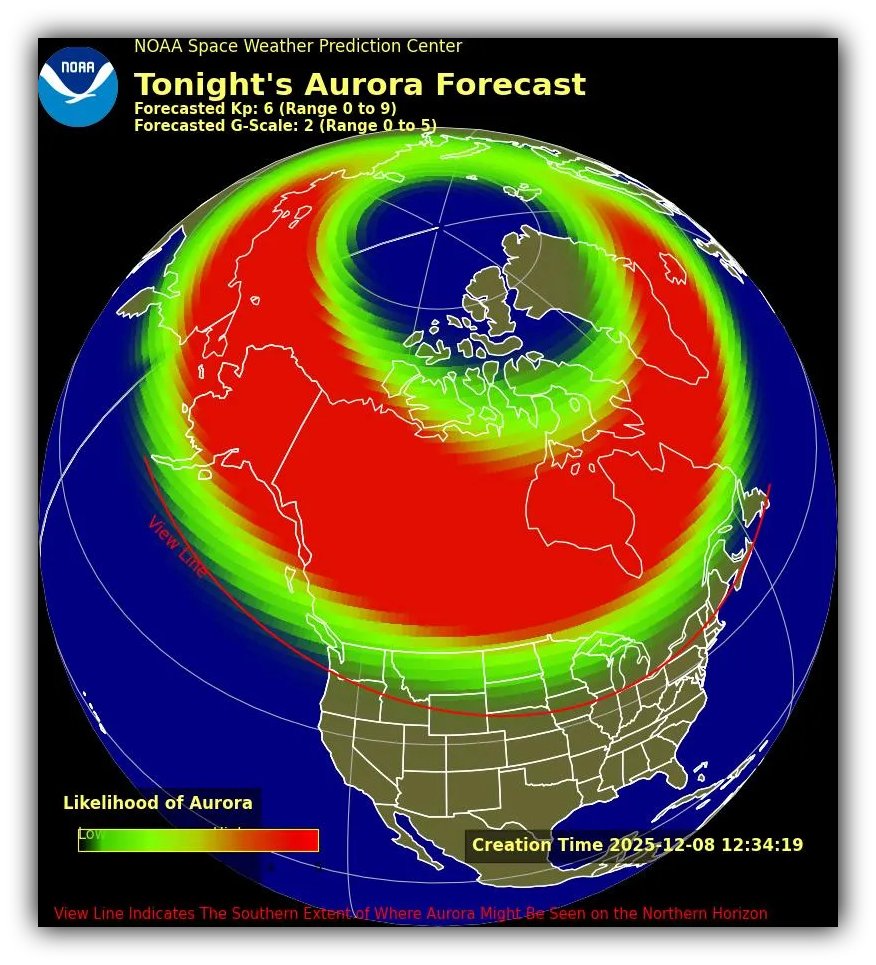
NOAA’s latest aurora forecast map highlights increased chances for northern-lights activity across Alaska tonight as a strong geomagnetic storm approaches Earth, driven by a recent full-halo coronal mass ejection from the Sun. (Credit: NOAA)
By Gina Hill | Alaska Headline Living | December 2025
Alaskans may have a chance to see aurora activity tonight, depending on conditions. According to the latest NOAA Space Weather Prediction Center forecasts, a strong geomagnetic storm could impact Earth late Monday into early Tuesday, increasing the likelihood of northern-lights viewing across Southcentral Alaska, including the Mat-Su Valley and Wasilla.
The potential storm stems from a full-halo coronal mass ejection (CME) launched from the Sun on December 6. The eruption followed a powerful M8.1-class solar flare from active solar region AR 4299, and the resulting CME is directed toward Earth. It is expected to arrive sometime within a 24–36 hour window, which includes tonight’s overnight hours.
If the solar storm arrives with favorable magnetic orientation, a key factor in aurora strength. NOAA says activity could reach G3 geomagnetic storm levels, considered “strong.”
Aurora Outlook for Alaska: Encouraging, With Some Variables
Alaska sits within the center of the auroral oval, the region surrounding Earth’s poles where auroras most commonly occur. Even moderate geomagnetic activity can produce visible auroras here, and tonight’s setup may enhance those odds.
Current Alaska-based aurora-monitoring resources are calling for moderate activity, with the potential for stronger displays if the CME arrives more energetically than forecast. Outcomes could range from a faint glow on the horizon to vivid overhead displays, depending on real-time space-weather conditions and local weather.
One of the biggest uncertainties tonight is cloud cover and wind. Strong winds continue across parts of Southcentral Alaska, and ongoing outages and gusty conditions may limit visibility or willingness to venture outside.
Timing the Show
If viewing conditions improve, the most favorable window is expected:
- After dark through the late evening
- Overnight into early Tuesday morning, especially if the CME arrives toward the later end of NOAA’s predicted window
Aurora timing is notoriously difficult to pinpoint, and tonight’s arrival estimate carries a “± several hours” margin, meaning peak activity could shift earlier or later than anticipated. The auroral oval may also expand or contract depending on the storm’s magnetic alignment when it reaches Earth.
How to Maximize Your Chances Tonight
For those hoping to catch a glimpse:
- Check the OVATION Aurora Dashboard from NOAA’s Space Weather Prediction Center for real-time activity; the 30-minute forecast tool is especially useful.
- Seek darker areas away from city lights to reduce light pollution.
- Watch for cloud breaks, even brief ones.
- Face north from a location with an open horizon.
- Be patient. Auroras can intensify and fade in cycles.
Bottom Line
With the official NOAA alert, Alaska’s high-latitude location, and the potential strength of tonight’s solar storm, there is a reasonable chance of aurora visibility, particularly if skies clear. Whether the weather cooperates and whether conditions entice residents outside remains to be seen.
What do you feel about this post?

Like

Love

Happy

Haha

Sad