








Remove Yourself: Boundary or Excuse?
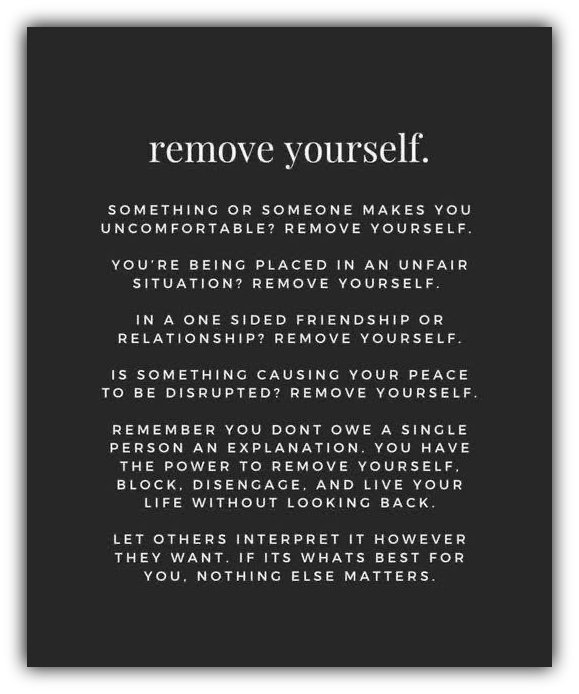
A blunt quote graphic tells readers to “remove yourself,” leaving the real question: boundary-setting or just an easy escape hatch? Source image shared on Instagram by buddhismpagefb.
When leaving is healthy, and when it’s just dodging.
By Gina Hill | Alaska Headline Living | July 8, 2026
There’s a certain kind of advice that shows up online all polished and ready to be framed as wisdom. But, on closer inspection, it may be less “healing truth” and more “well-packaged avoidance.” “Remove yourself” is one of those phrases.
And to be fair, sometimes it is absolutely the right move.
If the situation is toxic, dangerous, degrading, manipulative, or repeatedly draining your peace, then yes. Leave. Walk away. Block the number. Close the door. Protect your nervous system like it has better plans for the evening. Some things do not deserve your continued access, your explanation, or your emotional labor.
But, let’s not act like every uncomfortable moment is a sign that you need to vanish into the mist.
Discomfort Is Not Automatically Harm
This is where the slogan starts getting a little too loose with the truth. Not every awkward conversation is abusive, and not every disagreement is disrespect. Sometimes you are not being harmed at all; you are simply being challenged, called out, or asked to deal with something uncomfortable.
That is not always a cue to leave. Sometimes it is a cue to stay long enough to understand what is actually happening.
Boundary or Dodge?
Here’s the real test: Are you removing yourself because the situation is genuinely unhealthy, or because it’s inconvenient, messy, or requires you to be accountable?
That is the line between a boundary and a dodge.
A boundary says, “I will not stay where I am repeatedly disrespected, manipulated, or diminished.”
A dodge says, “I do not want to feel this, explain this, or face this, so I’m leaving and calling it self-care.”
Those are not the same thing, even if they both sound empowering in a quote graphic with dramatic font.
The Part People Skip
The truth is, “remove yourself” only works as wisdom when it is used with discernment. Some people need the exit door. Some situations need a conversation. Some need a firm boundary and a little backbone. And, some need you to sit in the discomfort long enough to figure out whether the problem is truly the situation … or just your refusal to tolerate anything that isn’t easy.
That last part stings a little, which is probably why people skip it.
Hiding is not the same as peace, and running away is not the same as self-protection.
Boundary or Escape
“Remove yourself” is excellent advice when you are stepping out of harm’s way. It loses its force when it becomes an excuse to avoid discomfort, sidestep accountability, or duck out of any conversation that requires maturity. Boundaries are healthy when they are honest; they are not a shield for hiding.
Leaving is right when it protects your peace. It is just escape when it protects you from the truth.
Sources
- American Psychological Association, “The benefits of better boundaries in clinical practice.”
- Mayo Clinic, “Being assertive: Reduce stress, communicate better.”
- Mayo Clinic Health System, “Setting boundaries for your well-being.”
- National Library of Medicine / PubMed, “The relative efficacy of avoidant and nonavoidant coping strategies: a meta-analysis.”
- PubMed Central, “Explorations of avoidance and approach coping and stress reactions.”
What do you feel about this post?

Like

Love

Happy

Haha

Sad